Section I Multiple choice
Functions & graphs
Show solution Hide solution for Question 1 + An absolute value less than 5 means − 5 < 2 x + 3 < 5 -5<2x+3<5 − 5 < 2 x + 3 < 5
Solution time 00:00
Not started
Pause
Reset
Vectors
Show solution Hide solution for Question 2 + The scalar product is u ⋅ v = 1 ( 2 ) + 2 ( − 3 ) = − 4 \mathbf u\cdot\mathbf v=1(2)+2(-3)=-4 u ⋅ v = 1 ( 2 ) + 2 ( − 3 ) = − 4 ∣ v ∣ 2 = 2 2 + ( − 3 ) 2 = 13 |\mathbf v|^2=2^2+(-3)^2=13 ∣ v ∣ 2 = 2 2 + ( − 3 ) 2 = 13 v \mathbf v v Answer B:
− 4 13 ( 2 i − 3 j ) -\dfrac4{13}(2\mathbf i-3\mathbf j) − 13 4 ( 2 i − 3 j ) .
Solution time 00:00
Not started
Pause
Reset
Integration Trigonometry
Show solution Hide solution for Question 3 + With x = 5 sin θ x=5\sin\theta x = 5 sin θ d x = 5 cos θ d θ dx=5\cos\theta\,d\theta d x = 5 cos θ d θ 25 − x 2 = 25 cos 2 θ 25-x^2=25\cos^2\theta 25 − x 2 = 25 cos 2 θ − π / 6 -\pi/6 − π /6 π / 6 \pi/6 π /6 Thus d x 25 − x 2 = 1 5 sec θ d θ \dfrac{dx}{25-x^2}=\dfrac15\sec\theta\,d\theta 25 − x 2 d x = 5 1 sec θ d θ Answer B:
1 5 ∫ − π / 6 π / 6 sec θ d θ \dfrac15\displaystyle\int_{-\pi/6}^{\pi/6}\sec\theta\,d\theta 5 1 ∫ − π /6 π /6 sec θ d θ .
Solution time 00:00
Not started
Pause
Reset
Probability Binomial distribution
Show solution Hide solution for Question 4 + The success probability is p = P ( X = 1 ) = 2 / 3 p=P(X=1)=2/3 p = P ( X = 1 ) = 2/3 p p p p ( 1 − p ) p(1-p) p ( 1 − p ) Answer C:
E ( X ) = 2 3 , Var ( X ) = 2 9 E(X)=\dfrac23,\quad\operatorname{Var}(X)=\dfrac29 E ( X ) = 3 2 , Var ( X ) = 9 2 .
Solution time 00:00
Not started
Pause
Reset
Trigonometry
Show solution Hide solution for Question 5 + Write sin x = cos ( π / 2 − x ) \sin x=\cos(\pi/2-x) sin x = cos ( π /2 − x ) cos 5 x + sin x = 2 cos ( 2 x + π / 4 ) cos ( 3 x − π / 4 ) . \cos5x+\sin x=2\cos(2x+\pi/4)\cos(3x-\pi/4). cos 5 x + sin x = 2 cos ( 2 x + π /4 ) cos ( 3 x − π /4 ) . The first factor gives x = π / 8 + k π / 2 x=\pi/8+k\pi/2 x = π /8 + kπ /2 k = 0 , 1 , 2 , 3 k=0,1,2,3 k = 0 , 1 , 2 , 3 x = π / 4 + k π / 3 x=\pi/4+k\pi/3 x = π /4 + kπ /3 k = 0 , 1 , … , 5 k=0,1,\ldots,5 k = 0 , 1 , … , 5 4 + 6 4+6 4 + 6
Solution time 00:00
Not started
Pause
Reset
Integration Inverse trigonometry
Show solution Hide solution for Question 6 + The function tan − 1 x \tan^{-1}x tan − 1 x x 2 x^2 x 2 Answer D:
∫ − a a x 2 tan − 1 x d x = 0 \displaystyle\int_{-a}^{a}x^2\tan^{-1}x\,dx=0 ∫ − a a x 2 tan − 1 x d x = 0 .
Solution time 00:00
Not started
Pause
Reset
Differential equations
Show solution Hide solution for Question 7 + The slopes depend on the horizontal position only. They are zero on the y y y ∣ x ∣ |x| ∣ x ∣ x 2 x^2 x 2 Answer A:
d y d x = x 2 \dfrac{dy}{dx}=x^2 d x d y = x 2 .
Solution time 00:00
Not started
Pause
Reset
Vectors
Show solution Hide solution for Question 8 + Rearrange c = 3 a − 2 b \mathbf c=3\mathbf a-2\mathbf b c = 3 a − 2 b a = ( 2 / 3 ) b + ( 1 / 3 ) c \mathbf a=(2/3)\mathbf b+(1/3)\mathbf c a = ( 2/3 ) b + ( 1/3 ) c Answer A: A lies between B and C.
Solution time 00:00
Not started
Pause
Reset
Vectors Trigonometry
Show solution Hide solution for Question 9 + Since a + b = − c \mathbf a+\mathbf b=-\mathbf c a + b = − c 49 = 9 + 25 + 2 ( 3 ) ( 5 ) cos θ 49=9+25+2(3)(5)\cos\theta 49 = 9 + 25 + 2 ( 3 ) ( 5 ) cos θ cos θ = 1 / 2 \cos\theta=1/2 cos θ = 1/2 Answer B:
θ = π / 3 \theta=\pi/3 θ = π /3 .
Solution time 00:00
Not started
Pause
Reset
Differentiation Inverse functions
Show solution Hide solution for Question 10 + From f ( g ( x ) ) = x f(g(x))=x f ( g ( x )) = x f ′ ( g ) g ′ = 1 f'(g)g'=1 f ′ ( g ) g ′ = 1 f ′ ′ ( g ) ( g ′ ) 2 + f ′ ( g ) g ′ ′ = 0 f''(g)(g')^2+f'(g)g''=0 f ′′ ( g ) ( g ′ ) 2 + f ′ ( g ) g ′′ = 0 At x = 1 x=1 x = 1 g ( 1 ) = 3 g(1)=3 g ( 1 ) = 3 g ′ ( 1 ) = 1 / 2 g'(1)=1/2 g ′ ( 1 ) = 1/2 4 ( 1 / 2 ) 2 + 2 g ′ ′ ( 1 ) = 0 4(1/2)^2+2g''(1)=0 4 ( 1/2 ) 2 + 2 g ′′ ( 1 ) = 0 Answer C:
g ′ ′ ( 1 ) = − 1 2 g''(1)=-\dfrac12 g ′′ ( 1 ) = − 2 1 .
Solution time 00:00
Not started
Pause
Reset
Section II Written responses
Inverse functions Algebra
Show solution Hide solution for Question 11(a) + Set y = 1 − 1 / ( x − 2 ) y=1-1/(x-2) y = 1 − 1/ ( x − 2 ) 1 − y = 1 / ( x − 2 ) 1-y=1/(x-2) 1 − y = 1/ ( x − 2 ) x = 2 + 1 / ( 1 − y ) x=2+1/(1-y) x = 2 + 1/ ( 1 − y ) Answer f − 1 ( x ) = 2 − 1 x − 1 , x ≠ 1 f^{-1}(x)=2-\dfrac1{x-1},\quad x\ne1 f − 1 ( x ) = 2 − x − 1 1 , x = 1 .
Solution time 00:00
Not started
Pause
Reset
Trigonometry
Show solution Hide solution for Question 11(b) + Use sin 2 θ = 2 sin θ cos θ \sin2\theta=2\sin\theta\cos\theta sin 2 θ = 2 sin θ cos θ sin θ ( 2 cos θ − 1 ) = 0 \sin\theta(2\cos\theta-1)=0 sin θ ( 2 cos θ − 1 ) = 0 The sine factor gives the endpoints 0 and π \pi π cos θ = 1 / 2 \cos\theta=1/2 cos θ = 1/2 θ = π / 3 \theta=\pi/3 θ = π /3 Answer θ = 0 , π / 3 , π \theta=0,\ \pi/3,\ \pi θ = 0 , π /3 , π .
Solution time 00:00
Not started
Pause
Reset
Integration Trigonometry
Show solution Hide solution for Question 11(c) + The product-to-sum identity gives sin 3 x cos x = 1 2 ( sin 4 x + sin 2 x ) \sin3x\cos x=\tfrac12(\sin4x+\sin2x) sin 3 x cos x = 2 1 ( sin 4 x + sin 2 x ) Answer − 1 8 cos 4 x − 1 4 cos 2 x + C \displaystyle-\frac18\cos4x-\frac14\cos2x+C − 8 1 cos 4 x − 4 1 cos 2 x + C .
Solution time 00:00
Not started
Pause
Reset
Functions & graphs Inverse trigonometry
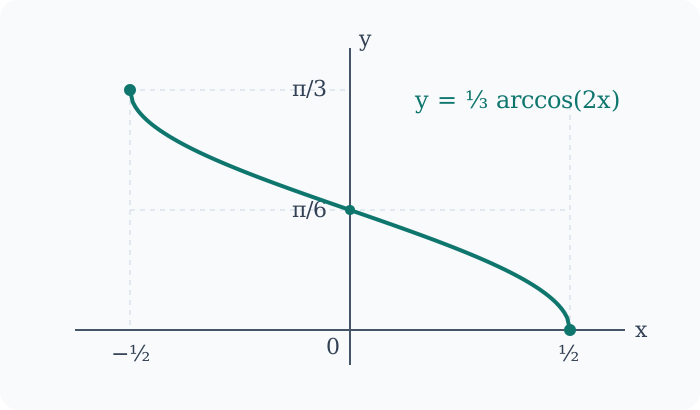
Show solution Hide solution for Question 11(d) + The input of inverse cosine must satisfy − 1 ≤ 2 x ≤ 1 -1\le2x\le1 − 1 ≤ 2 x ≤ 1 [ − 1 / 2 , 1 / 2 ] [-1/2,1/2] [ − 1/2 , 1/2 ] 1 / 3 1/3 1/3 [ 0 , π / 3 ] [0,\pi/3] [ 0 , π /3 ] Draw a smooth decreasing curve through ( − 1 / 2 , π / 3 ) (-1/2,\pi/3) ( − 1/2 , π /3 ) ( 0 , π / 6 ) (0,\pi/6) ( 0 , π /6 ) ( 1 / 2 , 0 ) (1/2,0) ( 1/2 , 0 ) Original solution sketch; see the steps for key values. Answer Domain
[ − 1 / 2 , 1 / 2 ] [-1/2,1/2] [ − 1/2 , 1/2 ] ; range
[ 0 , π / 3 ] [0,\pi/3] [ 0 , π /3 ] .
Solution time 00:00
Not started
Pause
Reset
Vectors
Show solution Hide solution for Question 11(e) + The vector ( 2 , 6 ) (2,6) ( 2 , 6 ) ( 1 , 3 ) (1,3) ( 1 , 3 )
Solution time 00:00
Not started
Pause
Reset
Polynomials Algebra
Show solution Hide solution for Question 11(f) + Put the fractions over a common denominator: 1 / ( α β ) + 1 / ( α γ ) + 1 / ( β γ ) = ( α + β + γ ) / ( α β γ ) 1/(\alpha\beta)+1/(\alpha\gamma)+1/(\beta\gamma)=(\alpha+\beta+\gamma)/(\alpha\beta\gamma) 1/ ( α β ) + 1/ ( α γ ) + 1/ ( β γ ) = ( α + β + γ ) / ( α β γ ) Vieta’s formulas give the sum − 6 / 2 = − 3 -6/2=-3 − 6/2 = − 3 − ( − 1 ) / 2 = 1 / 2 -(-1)/2=1/2 − ( − 1 ) /2 = 1/2
Solution time 00:00
Not started
Pause
Reset
Integration Trigonometry
Show solution Hide solution for Question 11(g) + Reduce the power using cos 2 ( 3 x ) = ( 1 + cos 6 x ) / 2 \cos^2(3x)=(1+\cos6x)/2 cos 2 ( 3 x ) = ( 1 + cos 6 x ) /2 x / 2 + sin 6 x / 12 x/2+\sin6x/12 x /2 + sin 6 x /12 The sine terms vanish at both x = π / 6 x=\pi/6 x = π /6 x = π / 3 x=\pi/3 x = π /3 π / 6 − π / 12 \pi/6-\pi/12 π /6 − π /12
Solution time 00:00
Not started
Pause
Reset
Rates of change Differentiation
Show solution Hide solution for Question 12(a) + The fixed area gives 1 2 r 2 θ = 10 \tfrac12r^2\theta=10 2 1 r 2 θ = 10 r = 4 r=4 r = 4 θ = 20 / 16 = 5 / 4 \theta=20/16=5/4 θ = 20/16 = 5/4 Differentiate with respect to time: r θ d r / d t + 1 2 r 2 d θ / d t = 0 r\theta\,dr/dt+\tfrac12r^2\,d\theta/dt=0 r θ d r / d t + 2 1 r 2 d θ / d t = 0 d θ / d t = 2 d\theta/dt=2 d θ / d t = 2 5 d r / d t + 16 = 0 5\,dr/dt+16=0 5 d r / d t + 16 = 0 Answer d r d t = − 3.2 cm s − 1 \dfrac{dr}{dt}=-3.2\text{ cm s}^{-1} d t d r = − 3.2 cm s − 1 : the radius is decreasing.
Solution time 00:00
Not started
Pause
Reset
Integration Volumes of revolution
Show solution Hide solution for Question 12(b) + Express the radius of a horizontal disc in terms of its height: x = 1 / y x=1/y x = 1/ y π x 2 = π / y 2 \pi x^2=\pi/y^2 π x 2 = π / y 2 V = π ∫ 1 a y − 2 d y = π [ − 1 / y ] 1 a . V=\pi\int_1^a y^{-2}\,dy=\pi[-1/y]_1^a. V = π ∫ 1 a y − 2 d y = π [ − 1/ y ] 1 a . Answer V = π ( 1 − 1 / a ) V=\pi(1-1/a) V = π ( 1 − 1/ a ) cubic units.
Solution time 00:00
Not started
Pause
Reset
Mathematical induction
Show solution Hide solution for Question 12(c) + Base case n = 1 n=1 n = 1 2 ! − 1 = 1 2!-1=1 2 ! − 1 = 1 Assume ∑ j = 1 k j ( j ! ) = ( k + 1 ) ! − 1 \sum_{j=1}^{k}j(j!)=(k+1)!-1 ∑ j = 1 k j ( j !) = ( k + 1 )! − 1 ∑ j = 1 k + 1 j ( j ! ) = ( k + 1 ) ! − 1 + ( k + 1 ) ( k + 1 ) ! = ( k + 2 ) ! − 1. \sum_{j=1}^{k+1}j(j!)=(k+1)!-1+(k+1)(k+1)!=(k+2)!-1. j = 1 ∑ k + 1 j ( j !) = ( k + 1 )! − 1 + ( k + 1 ) ( k + 1 )! = ( k + 2 )! − 1. This is precisely the required statement for k + 1 k+1 k + 1 Answer ∑ j = 1 n j ( j ! ) = ( n + 1 ) ! − 1 \displaystyle\sum_{j=1}^{n}j(j!)=(n+1)!-1 j = 1 ∑ n j ( j !) = ( n + 1 )! − 1 for all integers
n ≥ 1 n\ge1 n ≥ 1 .
Solution time 00:00
Not started
Pause
Reset
Differential equations Inverse trigonometry
Show solution Hide solution for Question 12(d) + Write d y / 4 − y 2 = d x dy/\sqrt{4-y^2}=dx d y / 4 − y 2 = d x sin − 1 ( y / 2 ) = x + C \sin^{-1}(y/2)=x+C sin − 1 ( y /2 ) = x + C At ( x , y ) = ( 0 , 1 ) (x,y)=(0,1) ( x , y ) = ( 0 , 1 ) C = π / 6 C=\pi/6 C = π /6 The sine expression solves the original equation on − 2 π / 3 ≤ x ≤ π / 3 -2\pi/3\le x\le\pi/3 − 2 π /3 ≤ x ≤ π /3 Answer y = 2 sin ( x + π / 6 ) y=2\sin(x+\pi/6) y = 2 sin ( x + π /6 ) on the branch through
( 0 , 1 ) (0,1) ( 0 , 1 ) .
Solution time 00:00
Not started
Pause
Reset
Trigonometry
Show solution Hide solution for Question 12(e)(i) + Expand 2 sin ( x − α ) = 2 cos α sin x − 2 sin α cos x 2\sin(x-\alpha)=2\cos\alpha\sin x-2\sin\alpha\cos x 2 sin ( x − α ) = 2 cos α sin x − 2 sin α cos x cos α = 3 / 2 \cos\alpha=\sqrt3/2 cos α = 3 /2 sin α = 1 / 2 \sin\alpha=1/2 sin α = 1/2 Answer 3 sin x − cos x = 2 sin ( x − π / 6 ) \sqrt3\sin x-\cos x=2\sin(x-\pi/6) 3 sin x − cos x = 2 sin ( x − π /6 ) , so
α = π / 6 \alpha=\pi/6 α = π /6 .
Solution time 00:00
Not started
Pause
Reset
Trigonometry
Show solution Hide solution for Question 12(e)(ii) + Part (i) turns the equation into 2 sin ( x − π / 6 ) = 1 2\sin(x-\pi/6)=1 2 sin ( x − π /6 ) = 1 For − π / 6 ≤ x − π / 6 ≤ 11 π / 6 -\pi/6\le x-\pi/6\le11\pi/6 − π /6 ≤ x − π /6 ≤ 11 π /6 1 / 2 1/2 1/2 π / 6 \pi/6 π /6 5 π / 6 5\pi/6 5 π /6 π / 6 \pi/6 π /6 Answer x = π / 3 , π x=\pi/3,\ \pi x = π /3 , π .
Solution time 00:00
Not started
Pause
Reset
Differential equations
Show solution Hide solution for Question 13(a) + Separate and integrate: y d y = 5 d x y\,dy=5\,dx y d y = 5 d x y 2 / 2 = 5 x + C y^2/2=5x+C y 2 /2 = 5 x + C C = 8 C=8 C = 8 y 2 = 10 x + 16 y^2=10x+16 y 2 = 10 x + 16 The initial value is negative, so choose the negative square root. Exclude the endpoint where y = 0 y=0 y = 0 y y y Answer y = − 10 x + 16 , x > − 8 / 5 y=-\sqrt{10x+16},\quad x>-8/5 y = − 10 x + 16 , x > − 8/5 .
Solution time 00:00
Not started
Pause
Reset
Combinatorics
Show solution Hide solution for Question 13(b) + Fix one guest to remove rotational duplicates. The unrestricted count is 7 ! 7! 7 ! For the forbidden arrangements, combine the two specified guests into one block. The resulting seven objects have 6 ! 6! 6 ! Answer 7 ! − 2 ( 6 ! ) = 3600 7!-2(6!)=3600 7 ! − 2 ( 6 !) = 3600 arrangements.
Solution time 00:00
Not started
Pause
Reset
Vectors Motion Differentiation
Show solution Hide solution for Question 13(c) + Differentiate the position vector: v = ( 1 , 2 t / 9 ) \mathbf v=(1,2t/9) v = ( 1 , 2 t /9 ) a = ( 0 , 2 / 9 ) \mathbf a=(0,2/9) a = ( 0 , 2/9 ) The dot-product formula gives cos ( π / 4 ) = 2 t / 81 + 4 t 2 \cos(\pi/4)=2t/\sqrt{81+4t^2} cos ( π /4 ) = 2 t / 81 + 4 t 2 t > 0 t>0 t > 0 Squaring yields 1 / 2 = 4 t 2 / ( 81 + 4 t 2 ) 1/2=4t^2/(81+4t^2) 1/2 = 4 t 2 / ( 81 + 4 t 2 ) 4 t 2 = 81 4t^2=81 4 t 2 = 81 Answer t = 9 / 2 = 4.5 t=9/2=4.5 t = 9/2 = 4.5 time units.
Solution time 00:00
Not started
Pause
Reset
Binomial distribution Normal distribution
Show solution Hide solution for Question 13(d) + With replacement, X ∼ Bin ( 100 , p ) X\sim\operatorname{Bin}(100,p) X ∼ Bin ( 100 , p ) 100 p = 20 100p=20 100 p = 20 p = 0.2 p=0.2 p = 0.2 σ = 100 ( 0.2 ) ( 0.8 ) = 4 \sigma=\sqrt{100(0.2)(0.8)}=4 σ = 100 ( 0.2 ) ( 0.8 ) = 4 The lower-tail probability is 1 − 0.0668 = 0.9332 1-0.0668=0.9332 1 − 0.0668 = 0.9332 P ( Z ≤ 1.5 ) = 0.9332 P(Z\le1.5)=0.9332 P ( Z ≤ 1.5 ) = 0.9332 Using the standard normal approximation requested in the question, ( k − 20 ) / 4 = 1.5 (k-20)/4=1.5 ( k − 20 ) /4 = 1.5
Solution time 00:00
Not started
Pause
Reset
Combinatorics Binomial coefficients
Show solution Hide solution for Question 13(e)(i) + Use Pascal’s identity with n = m + 1 n=m+1 n = m + 1 r = R + 1 r=R+1 r = R + 1 ( m + 1 R + 1 ) = ( m R ) + ( m R + 1 ) \binom{m+1}{R+1}=\binom mR+\binom m{R+1} ( R + 1 m + 1 ) = ( R m ) + ( R + 1 m ) Answer ( m R ) = ( m + 1 R + 1 ) − ( m R + 1 ) \displaystyle\binom mR=\binom{m+1}{R+1}-\binom m{R+1} ( R m ) = ( R + 1 m + 1 ) − ( R + 1 m ) .
Solution time 00:00
Not started
Pause
Reset
Combinatorics Binomial coefficients
Show solution Hide solution for Question 13(e)(ii) + Apply part (i) with R = 2000 R=2000 R = 2000 ( m 2000 ) \binom m{2000} ( 2000 m ) ( m + 1 2001 ) − ( m 2001 ) \binom{m+1}{2001}-\binom m{2001} ( 2001 m + 1 ) − ( 2001 m ) Summing for m = 2000 , … , 2050 m=2000,\ldots,2050 m = 2000 , … , 2050 ( 2051 2001 ) − ( 2000 2001 ) \binom{2051}{2001}-\binom{2000}{2001} ( 2001 2051 ) − ( 2001 2000 ) Answer ∑ m = 2000 2050 ( m 2000 ) = ( 2051 2001 ) \displaystyle\sum_{m=2000}^{2050}\binom m{2000}=\binom{2051}{2001} m = 2000 ∑ 2050 ( 2000 m ) = ( 2001 2051 ) .
Solution time 00:00
Not started
Pause
Reset
Proof Number theory
Show solution Hide solution for Question 14(a) + Among the positive factors of 60, only four are odd: 1, 3, 5 and 15. Any seven selected factors therefore include at least three even numbers, supplying more than the two factors of 2 needed. Only six factors avoid a multiple of 3: 1, 2, 4, 5, 10 and 20. Likewise only six avoid a multiple of 5: 1, 2, 3, 4, 6 and 12. Seven selections must therefore supply both a factor of 3 and a factor of 5. Thus the product is divisible by 2 2 × 3 × 5 = 60 2^2\times3\times5=60 2 2 × 3 × 5 = 60 Answer The product of any seven distinct positive factors of 60 is a multiple of 60.
Solution time 00:00
Not started
Pause
Reset
Projectile motion Motion
Show solution Hide solution for Question 14(b) + Let O B = h OB=h OB = h O A = k h OA=kh O A = kh t A = 2 k h / g t_A=\sqrt{2kh/g} t A = 2 kh / g t B = 2 h / g t_B=\sqrt{2h/g} t B = 2 h / g They have the same horizontal range, so U t A = V t B Ut_A=Vt_B U t A = V t B V / U = t A / t B = k V/U=t_A/t_B=\sqrt{k} V / U = t A / t B = k Answer V U = k \dfrac VU=\sqrt{k} U V = k , which depends only on
k k k .
Solution time 00:00
Not started
Pause
Reset
Vectors Trigonometry
Show solution Hide solution for Question 14(c) + Perpendicular vectors have zero dot product. Dividing that product by 2 and using cos ( A − B ) = cos A cos B + sin A sin B \cos(A-B)=\cos A\cos B+\sin A\sin B cos ( A − B ) = cos A cos B + sin A sin B cos ( 11 π t / 360 ) = 0 \cos(11\pi t/360)=0 cos ( 11 π t /360 ) = 0 The first two positive angles are π / 2 \pi/2 π /2 3 π / 2 3\pi/2 3 π /2 180 / 11 180/11 180/11 540 / 11 540/11 540/11 Answer t = 16.364 t=16.364 t = 16.364 minutes and
t = 49.091 t=49.091 t = 49.091 minutes.
Solution time 00:00
Not started
Pause
Reset
Differentiation Inverse trigonometry
Show solution Hide solution for Question 14(d) + The chain rule gives f ′ ( x ) = − cos x / 1 − sin 2 x = − cos x / ∣ cos x ∣ f'(x)=-\cos x/\sqrt{1-\sin^2x}=-\cos x/|\cos x| f ′ ( x ) = − cos x / 1 − sin 2 x = − cos x /∣ cos x ∣ Cosine is positive on ( 0 , π / 2 ) (0,\pi/2) ( 0 , π /2 ) ( π / 2 , π ) (\pi/2,\pi) ( π /2 , π ) π / 2 \pi/2 π /2 Answer f ′ ( x ) = { − 1 , 0 < x < π / 2 , 1 , π / 2 < x < π . f'(x)=\begin{cases}-1,&0<x<\pi/2,\\1,&\pi/2<x<\pi.\end{cases} f ′ ( x ) = { − 1 , 1 , 0 < x < π /2 , π /2 < x < π . Undefined at
x = π / 2 x=\pi/2 x = π /2 .
Solution time 00:00
Not started
Pause
Reset
Polynomials Trigonometry
Show solution Hide solution for Question 14(e) + Let the roots be p = tan α p=\tan\alpha p = tan α q = tan β q=\tan\beta q = tan β r = tan γ r=\tan\gamma r = tan γ p + q + r = − b p+q+r=-b p + q + r = − b p q + p r + q r = c pq+pr+qr=c pq + p r + q r = c p q r = 1 − b − c pqr=1-b-c pq r = 1 − b − c The three-angle tangent identity now gives tan ( α + β + γ ) = p + q + r − p q r 1 − p q − p r − q r = − b − ( 1 − b − c ) 1 − c = − 1 \tan(\alpha+\beta+\gamma)=\dfrac{p+q+r-pqr}{1-pq-pr-qr}=\dfrac{-b-(1-b-c)}{1-c}=-1 tan ( α + β + γ ) = 1 − pq − p r − q r p + q + r − pq r = 1 − c − b − ( 1 − b − c ) = − 1 c ≠ 1 c\ne1 c = 1 The angle sums are − π / 4 + n π -\pi/4+n\pi − π /4 + nπ n = 1 n=1 n = 1 Answer α + β + γ = 3 π / 4 \alpha+\beta+\gamma=3\pi/4 α + β + γ = 3 π /4 is the smallest positive value.
Solution time 00:00
Not started
Pause
Reset