Section I Multiple choice
Vectors Coordinate geometry
Show solution Hide solution for Question 1 + The direction from ( − 3 , 1 ) (-3,1) ( − 3 , 1 ) ( 1 , 4 ) (1,4) ( 1 , 4 ) ( 4 , 3 ) (4,3) ( 4 , 3 ) ( − 3 , 1 ) (-3,1) ( − 3 , 1 ) Answer D:
( x y ) = ( − 3 1 ) + λ ( 4 3 ) \begin{pmatrix}x\\y\end{pmatrix}=\begin{pmatrix}-3\\1\end{pmatrix}+\lambda\begin{pmatrix}4\\3\end{pmatrix} ( x y ) = ( − 3 1 ) + λ ( 4 3 ) .
Solution time 00:00
Not started
Pause
Reset
Proof Logic
Show solution Hide solution for Question 2 + Negating “there exists an integer whose square is odd” gives “for every integer, its square is not odd”. An integer square is either odd or even. Answer B:
∀ x ∈ Z , x 2 is even . \forall x\in\mathbb Z,\ x^2\text{ is even}. ∀ x ∈ Z , x 2 is even .
Solution time 00:00
Not started
Pause
Reset
Complex numbers
Show solution Hide solution for Question 3 + Squaring 2 − i 2-i 2 − i 4 − 4 i + i 2 = 3 − 4 i 4-4i+i^2=3-4i 4 − 4 i + i 2 = 3 − 4 i Answer C:
2 − i 2-i 2 − i and
− 2 + i -2+i − 2 + i .
Solution time 00:00
Not started
Pause
Reset
Mechanics Simple harmonic motion
Show solution Hide solution for Question 4 + The speed is zero at the turning points: − x 2 + 2 x + 8 = 0 -x^2+2x+8=0 − x 2 + 2 x + 8 = 0 x = − 2 x=-2 x = − 2 x = 4 x=4 x = 4 1 1 1 3 3 3
Solution time 00:00
Not started
Pause
Reset
Proof Logic
Show solution Hide solution for Question 5 + For P ⇒ Q P\Rightarrow Q P ⇒ Q ¬ Q ⇒ ¬ P \neg Q\Rightarrow\neg P ¬ Q ⇒ ¬ P ¬ Q \neg Q ¬ Q x > 0 x>0 x > 0 ¬ P \neg P ¬ P x 2 − 2 x < 0 x^2-2x<0 x 2 − 2 x < 0 Answer A: If
x > 0 x>0 x > 0 , then
x 2 − 2 x < 0 x^2-2x<0 x 2 − 2 x < 0 .
Solution time 00:00
Not started
Pause
Reset
Complex numbers
Show solution Hide solution for Question 6 + For unit complex numbers, ∣ z + w ∣ 2 + ∣ z − w ∣ 2 = 2 ∣ z ∣ 2 + 2 ∣ w ∣ 2 = 4 |z+w|^2+|z-w|^2=2|z|^2+2|w|^2=4 ∣ z + w ∣ 2 + ∣ z − w ∣ 2 = 2∣ z ∣ 2 + 2∣ w ∣ 2 = 4 ∣ z − w ∣ 2 = 4 − 9 4 = 7 4 |z-w|^2=4-\frac94=\frac74 ∣ z − w ∣ 2 = 4 − 4 9 = 4 7 Answer B:
∣ z − w ∣ = 7 2 . |z-w|=\frac{\sqrt7}{2}. ∣ z − w ∣ = 2 7 .
Solution time 00:00
Not started
Pause
Reset
Complex numbers Geometry
Show solution Hide solution for Question 7 + The points z − 2 i z-2i z − 2 i 1 1 1 − 2 i -2i − 2 i arcsin ( 1 / 2 ) = π / 6 \arcsin(1/2)=\pi/6 arcsin ( 1/2 ) = π /6 − π / 2 -\pi/2 − π /2 Answer D:
− 2 π 3 ≤ Arg ( z − 2 i ) ≤ − π 3 . -\frac{2\pi}{3}\leq\operatorname{Arg}(z-2i)\leq-\frac{\pi}{3}. − 3 2 π ≤ Arg ( z − 2 i ) ≤ − 3 π .
Solution time 00:00
Not started
Pause
Reset
Mechanics Calculus
Show solution Hide solution for Question 8 + Since a = d v d t = d v d x d x d t = v d v d x a=\frac{dv}{dt}=\frac{dv}{dx}\frac{dx}{dt}=v\frac{dv}{dx} a = d t d v = d x d v d t d x = v d x d v
Solution time 00:00
Not started
Pause
Reset
Complex numbers Geometry
Show solution Hide solution for Question 9 + The relation v + z = u + w v+z=u+w v + z = u + w U V W Z UVWZ U VW Z u − w = k i ( v − z ) u-w=ki(v-z) u − w = ki ( v − z )
Solution time 00:00
Not started
Pause
Reset
Vectors Parametric curves
Show solution Hide solution for Question 10 + Set the parameter in option D to s = 2 t + π / 2 s=2t+\pi/2 s = 2 t + π /2 ( cos s , s , − sin s ) (\cos s,s,-\sin s) ( cos s , s , − sin s ) ( cos t , − t , sin t ) (\cos t,-t,\sin t) ( cos t , − t , sin t ) s = − t s=-t s = − t
Solution time 00:00
Not started
Pause
Reset
Section II Written responses
Complex numbers
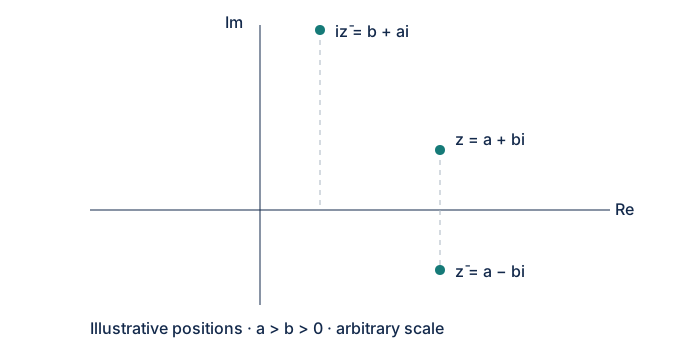
Show solution Hide solution for Question 11(a) + Write z = a + i b z=a+ib z = a + ib a , b > 0 a,b>0 a , b > 0 z ˉ = a − i b \bar z=a-ib z ˉ = a − ib z z z i z ˉ = b + i a i\bar z=b+ia i z ˉ = b + ia ( b , a ) (b,a) ( b , a ) Original solution sketch; see the steps for key values. Answer z ˉ \bar z z ˉ is the reflection of
z z z across the real axis;
i z ˉ i\bar z i z ˉ is the point
( b , a ) (b,a) ( b , a ) , in the first quadrant.
Solution time 00:00
Not started
Pause
Reset
Complex numbers
Show solution Hide solution for Question 11(b) + Multiply the moduli and add the arguments: w z = ( 2 ⋅ 3 ) e i ( π / 6 + π / 6 ) = 6 e i π / 3 wz=(2\cdot3)e^{i(\pi/6+\pi/6)}=6e^{i\pi/3} w z = ( 2 ⋅ 3 ) e i ( π /6 + π /6 ) = 6 e iπ /3 Answer Modulus
6 6 6 ; argument
π 3 \frac{\pi}{3} 3 π .
Solution time 00:00
Not started
Pause
Reset
Complex numbers
Show solution Hide solution for Question 11(c)(i) + Expand ( x + i y ) 2 (x+iy)^2 ( x + i y ) 2 i 2 = − 1 i^2=-1 i 2 = − 1 Answer z 2 = ( x 2 − y 2 ) + 2 x y i . z^2=(x^2-y^2)+2xyi. z 2 = ( x 2 − y 2 ) + 2 x y i .
Solution time 00:00
Not started
Pause
Reset
Complex numbers
Show solution Hide solution for Question 11(c)(ii) + Multiply numerator and denominator by the conjugate x − i y x-iy x − i y Answer 1 z = x − i y x 2 + y 2 = x x 2 + y 2 − y x 2 + y 2 i . \displaystyle\frac1z=\frac{x-iy}{x^2+y^2}=\frac{x}{x^2+y^2}-\frac{y}{x^2+y^2}i. z 1 = x 2 + y 2 x − i y = x 2 + y 2 x − x 2 + y 2 y i . This requires
z ≠ 0 z\ne0 z = 0 .
Solution time 00:00
Not started
Pause
Reset
Vectors Mechanics
Show solution Hide solution for Question 11(d)(i) + The direction vector has magnitude 2 2 + ( − 2 ) 2 + 1 2 = 3 \sqrt{2^2+(-2)^2+1^2}=3 2 2 + ( − 2 ) 2 + 1 2 = 3 12 / 3 = 4 12/3=4 12/3 = 4 Answer F 1 = 8 i − 8 j + 4 k . \mathbf F_1=8\mathbf i-8\mathbf j+4\mathbf k. F 1 = 8 i − 8 j + 4 k .
Solution time 00:00
Not started
Pause
Reset
Vectors Mechanics
Show solution Hide solution for Question 11(d)(ii) + Add the force components: ( 8 , − 8 , 4 ) + ( − 6 , 12 , 4 ) = ( 2 , 4 , 8 ) (8,-8,4)+(-6,12,4)=(2,4,8) ( 8 , − 8 , 4 ) + ( − 6 , 12 , 4 ) = ( 2 , 4 , 8 ) Answer F 3 = 2 i + 4 j + 8 k . \mathbf F_3=2\mathbf i+4\mathbf j+8\mathbf k. F 3 = 2 i + 4 j + 8 k .
Solution time 00:00
Not started
Pause
Reset
Vectors Mechanics
Show solution Hide solution for Question 11(d)(iii) + Take the componentwise dot product with d = ( 1 , 1 , 2 ) \mathbf d=(1,1,2) d = ( 1 , 1 , 2 ) 2 + 4 + 8 ⋅ 2 = 22 2+4+8\cdot2=22 2 + 4 + 8 ⋅ 2 = 22 Answer F 3 ⋅ d = 22. \mathbf F_3\cdot\mathbf d=22. F 3 ⋅ d = 22.
Solution time 00:00
Not started
Pause
Reset
Proof Inequalities
Show solution Hide solution for Question 11(e) + Assume the negation, 3 + 5 ≤ 11 \sqrt3+\sqrt5\leq\sqrt{11} 3 + 5 ≤ 11 8 + 2 15 ≤ 11 8+2\sqrt{15}\leq11 8 + 2 15 ≤ 11 2 15 ≤ 3 2\sqrt{15}\leq3 2 15 ≤ 3 60 ≤ 9 60\leq9 60 ≤ 9 Answer Therefore
3 + 5 > 11 \sqrt3+\sqrt5>\sqrt{11} 3 + 5 > 11 .
Solution time 00:00
Not started
Pause
Reset
Integration
Show solution Hide solution for Question 11(f) + Complete the square: 7 − x 2 − 6 x = 16 − ( x + 3 ) 2 7-x^2-6x=16-(x+3)^2 7 − x 2 − 6 x = 16 − ( x + 3 ) 2 u = ( x + 3 ) / 4 u=(x+3)/4 u = ( x + 3 ) /4 Answer ∫ 5 7 − x 2 − 6 x d x = 5 sin − 1 ( x + 3 4 ) + C . \displaystyle\int\frac{5}{\sqrt{7-x^2-6x}}\,dx=5\sin^{-1}\!\left(\frac{x+3}{4}\right)+C. ∫ 7 − x 2 − 6 x 5 d x = 5 sin − 1 ( 4 x + 3 ) + C .
Solution time 00:00
Not started
Pause
Reset
Integration
Show solution Hide solution for Question 12(a) + Choose u = x u=x u = x d v = sin x d x dv=\sin x\,dx d v = sin x d x d u = d x du=dx d u = d x v = − cos x v=-\cos x v = − cos x ∫ 0 π / 2 x sin x d x = [ − x cos x ] 0 π / 2 + ∫ 0 π / 2 cos x d x \int_0^{\pi/2}x\sin x\,dx=[-x\cos x]_0^{\pi/2}+\int_0^{\pi/2}\cos x\,dx ∫ 0 π /2 x sin x d x = [ − x cos x ] 0 π /2 + ∫ 0 π /2 cos x d x The product term is zero at both endpoints. The remaining integral is [ sin x ] 0 π / 2 = 1 [\sin x]_0^{\pi/2}=1 [ sin x ] 0 π /2 = 1
Solution time 00:00
Not started
Pause
Reset
Proof Induction Calculus
Show solution Hide solution for Question 12(b) + For n = 1 n=1 n = 1 y ′ = ( 2 x + 1 ) e 2 x y^{\prime}=(2x+1)e^{2x} y ′ = ( 2 x + 1 ) e 2 x Assume y ( k ) = ( 2 k x + k 2 k − 1 ) e 2 x y^{(k)}=(2^kx+k2^{k-1})e^{2x} y ( k ) = ( 2 k x + k 2 k − 1 ) e 2 x k ≥ 1 k\ge1 k ≥ 1 y ( k + 1 ) = [ 2 k + 2 ( 2 k x + k 2 k − 1 ) ] e 2 x y^{(k+1)}=[2^k+2(2^kx+k2^{k-1})]e^{2x} y ( k + 1 ) = [ 2 k + 2 ( 2 k x + k 2 k − 1 )] e 2 x Simplifying yields [ 2 k + 1 x + ( k + 1 ) 2 k ] e 2 x [2^{k+1}x+(k+1)2^k]e^{2x} [ 2 k + 1 x + ( k + 1 ) 2 k ] e 2 x k + 1 k+1 k + 1 Answer y ( n ) = ( 2 n x + n 2 n − 1 ) e 2 x y^{(n)}=(2^nx+n2^{n-1})e^{2x} y ( n ) = ( 2 n x + n 2 n − 1 ) e 2 x , for all integers
n ≥ 1 n\ge1 n ≥ 1 .
Solution time 00:00
Not started
Pause
Reset
Complex numbers
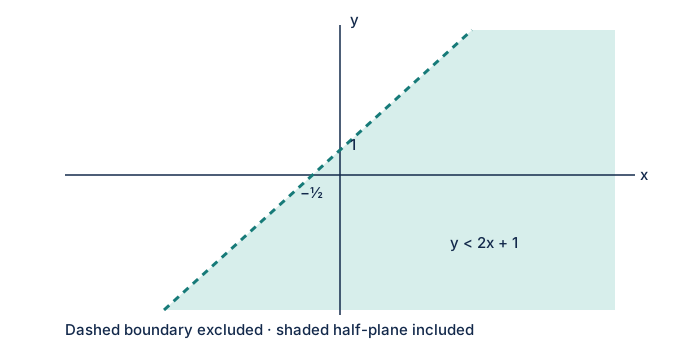
Show solution Hide solution for Question 12(c) + Write z = x + i y z=x+iy z = x + i y ( x + 5 ) 2 + ( y − 1 ) 2 > ( x − 3 ) 2 + ( y + 3 ) 2 (x+5)^2+(y-1)^2>(x-3)^2+(y+3)^2 ( x + 5 ) 2 + ( y − 1 ) 2 > ( x − 3 ) 2 + ( y + 3 ) 2 After cancellation, 16 x − 8 y + 8 > 0 16x-8y+8>0 16 x − 8 y + 8 > 0 y < 2 x + 1 y<2x+1 y < 2 x + 1 ( − 1 / 2 , 0 ) (-1/2,0) ( − 1/2 , 0 ) ( 0 , 1 ) (0,1) ( 0 , 1 ) Original solution sketch; see the steps for key values. Answer The open half-plane
y < 2 x + 1 y<2x+1 y < 2 x + 1 ; its boundary is excluded.
Solution time 00:00
Not started
Pause
Reset
Integration
Show solution Hide solution for Question 12(d) + Write the fraction as A / ( 4 − x ) + ( B x + C ) / ( x 2 + 1 ) A/(4-x)+(Bx+C)/(x^2+1) A / ( 4 − x ) + ( B x + C ) / ( x 2 + 1 ) x 2 − 2 x + 9 = A ( x 2 + 1 ) + ( B x + C ) ( 4 − x ) x^2-2x+9=A(x^2+1)+(Bx+C)(4-x) x 2 − 2 x + 9 = A ( x 2 + 1 ) + ( B x + C ) ( 4 − x ) Substituting x = 4 x=4 x = 4 A = 1 A=1 A = 1 x = 0 x=0 x = 0 C = 2 C=2 C = 2 B = 0 B=0 B = 0 1 / ( 4 − x ) + 2 / ( x 2 + 1 ) 1/(4-x)+2/(x^2+1) 1/ ( 4 − x ) + 2/ ( x 2 + 1 ) Integrate each term, allowing for the negative derivative of 4 − x 4-x 4 − x Answer − ln ∣ 4 − x ∣ + 2 tan − 1 x + C -\ln|4-x|+2\tan^{-1}x+C − ln ∣4 − x ∣ + 2 tan − 1 x + C .
Solution time 00:00
Not started
Pause
Reset
Mechanics Differential equations
Show solution Hide solution for Question 12(e) + Take distance s s s a = v d v / d s a=v\,dv/ds a = v d v / d s v d v / d s = − ( k + v 2 ) v\,dv/ds=-(k+v^2) v d v / d s = − ( k + v 2 ) Separate variables and integrate from initial speed V 0 V_0 V 0 S = − ∫ V 0 0 v / ( k + v 2 ) d v = − 1 2 [ ln ( k + v 2 ) ] V 0 0 S=-\int_{V_0}^{0}v/(k+v^2)\,dv=-\tfrac12[\ln(k+v^2)]_{V_0}^{0} S = − ∫ V 0 0 v / ( k + v 2 ) d v = − 2 1 [ ln ( k + v 2 ) ] V 0 0 The logarithms combine into a ratio. Since k > 0 k>0 k > 0 Answer S = 1 2 ln ( k + V 0 2 k ) m S=\frac12\ln\left(\frac{k+V_0^2}{k}\right)\text{ m} S = 2 1 ln ( k k + V 0 2 ) m .
Solution time 00:00
Not started
Pause
Reset
Integration
Show solution Hide solution for Question 13(a) + Use u = m − x u=m-x u = m − x d x = − d u dx=-du d x = − d u x = m − 4 x=m-4 x = m − 4 u = 4 u=4 u = 4 x = m − 2 x=m-2 x = m − 2 u = 2 u=2 u = 2 Also e − x = e − m e u e^{-x}=e^{-m}e^u e − x = e − m e u x − m + 1 = 1 − u x-m+1=1-u x − m + 1 = 1 − u e − m ∫ 4 2 e u / ( u − 1 ) d u e^{-m}\int_4^2 e^u/(u-1)\,du e − m ∫ 4 2 e u / ( u − 1 ) d u Reversing the endpoints introduces a minus sign, leaving the integral defining A A A Answer The integral equals
− e − m A -e^{-m}A − e − m A , so
k = − e − m k=-e^{-m} k = − e − m .
Solution time 00:00
Not started
Pause
Reset
Vectors
Show solution Hide solution for Question 13(b) + Perpendicularity gives 2 x + 4 y − 3 z = 0 2x+4y-3z=0 2 x + 4 y − 3 z = 0 − 4 x − 5 y + 3 z = 0 -4x-5y+3z=0 − 4 x − 5 y + 3 z = 0 y = − 2 x y=-2x y = − 2 x z = − 2 x z=-2x z = − 2 x The unit-length condition is x 2 + y 2 + z 2 = 1 x^2+y^2+z^2=1 x 2 + y 2 + z 2 = 1 9 x 2 = 1 9x^2=1 9 x 2 = 1 x = ± 1 / 3 x=\pm1/3 x = ± 1/3 y y y z z z Answer c = ± 1 3 ( 1 , − 2 , − 2 ) \mathbf c=\pm\frac13(1,-2,-2) c = ± 3 1 ( 1 , − 2 , − 2 ) .
Solution time 00:00
Not started
Pause
Reset
Proof Inequalities
Show solution Hide solution for Question 13(c)(i) + Since a , b > 0 a,b>0 a , b > 0 ( a − b ) 2 (\sqrt a-\sqrt b)^2 ( a − b ) 2 a + b − 2 a b ≥ 0 a+b-2\sqrt{ab}\ge0 a + b − 2 ab ≥ 0 Equality holds exactly when a = b a=b a = b Answer a + b 2 ≥ a b \frac{a+b}{2}\ge\sqrt{ab} 2 a + b ≥ ab .
Solution time 00:00
Not started
Pause
Reset
Proof Inequalities
Show solution Hide solution for Question 13(c)(ii) + Apply part (i) to a = 2 n + 1 a=2n+1 a = 2 n + 1 b = 2 n + 3 b=2n+3 b = 2 n + 3 n ≥ 0 n\ge0 n ≥ 0 ( 2 n + 1 ) ( 2 n + 3 ) < 2 n + 2 \sqrt{(2n+1)(2n+3)}<2n+2 ( 2 n + 1 ) ( 2 n + 3 ) < 2 n + 2 Divide by the positive quantity ( 2 n + 2 ) 2 n + 3 (2n+2)\sqrt{2n+3} ( 2 n + 2 ) 2 n + 3 2 n + 1 \sqrt{2n+1} 2 n + 1 Answer 2 n + 1 2 n + 2 < 2 n + 1 2 n + 3 \frac{2n+1}{2n+2}<\frac{\sqrt{2n+1}}{\sqrt{2n+3}} 2 n + 2 2 n + 1 < 2 n + 3 2 n + 1 , for every integer
n ≥ 0 n\ge0 n ≥ 0 .
Solution time 00:00
Not started
Pause
Reset
Integration Trigonometry
Show solution Hide solution for Question 13(d) + Call the given integral J J J u = π / 2 − x u=\pi/2-x u = π /2 − x J = ∫ 0 π / 2 ( π / 2 − x ) / ( 1 + sin x + cos x ) d x J=\int_0^{\pi/2}(\pi/2-x)/(1+\sin x+\cos x)\,dx J = ∫ 0 π /2 ( π /2 − x ) / ( 1 + sin x + cos x ) d x Adding this expression to the original gives 2 J = ( π / 2 ) K 2J=(\pi/2)K 2 J = ( π /2 ) K K = ∫ 0 π / 2 d x / ( 1 + sin x + cos x ) K=\int_0^{\pi/2}dx/(1+\sin x+\cos x) K = ∫ 0 π /2 d x / ( 1 + sin x + cos x ) J = π K / 4 J=\pi K/4 J = π K /4 For K K K t = tan ( x / 2 ) t=\tan(x/2) t = tan ( x /2 ) d t / ( 1 + t ) dt/(1+t) d t / ( 1 + t ) K = [ ln ( 1 + t ) ] 0 1 = ln 2 K=[\ln(1+t)]_0^1=\ln2 K = [ ln ( 1 + t ) ] 0 1 = ln 2 Answer J = π ln 2 4 J=\frac{\pi\ln2}{4} J = 4 π l n 2 .
Solution time 00:00
Not started
Pause
Reset
Integration Reduction formulas Trigonometry
Show solution Hide solution for Question 14(a)(i) + Separate the final factor of cot 2 θ \cot^2\theta cot 2 θ csc 2 θ − 1 \csc^2\theta-1 csc 2 θ − 1 I n = ∫ π / 4 π / 2 cot 2 n − 2 θ csc 2 θ d θ − I n − 1 . I_n=\int_{\pi/4}^{\pi/2}\cot^{2n-2}\theta\,\csc^2\theta\,d\theta-I_{n-1}. I n = ∫ π /4 π /2 cot 2 n − 2 θ csc 2 θ d θ − I n − 1 . The substitution u = cot θ u=\cot\theta u = cot θ − cot 2 n − 1 θ / ( 2 n − 1 ) -\cot^{2n-1}\theta/(2n-1) − cot 2 n − 1 θ / ( 2 n − 1 ) − 1 / ( 2 n − 1 ) -1/(2n-1) − 1/ ( 2 n − 1 ) Answer I n = 1 2 n − 1 − I n − 1 , n > 0 \displaystyle I_n=\frac1{2n-1}-I_{n-1},\quad n>0 I n = 2 n − 1 1 − I n − 1 , n > 0 .
Solution time 00:00
Not started
Pause
Reset
Integration Reduction formulas
Show solution Hide solution for Question 14(a)(ii) + The starting integral is I 0 = π / 4 I_0=\pi/4 I 0 = π /4 I 1 = 1 − π / 4 I_1=1-\pi/4 I 1 = 1 − π /4 I 2 = 1 / 3 − I 1 I_2=1/3-I_1 I 2 = 1/3 − I 1 Answer I 2 = π / 4 − 2 / 3 I_2=\pi/4-2/3 I 2 = π /4 − 2/3 .
Solution time 00:00
Not started
Pause
Reset
Motion Differential equations
Show solution Hide solution for Question 14(b)(i) + Use a = v d v / d x a=v\,dv/dx a = v d v / d x v d v = 32 x ( x 2 + 3 ) d x v\,dv=32x(x^2+3)\,dx v d v = 32 x ( x 2 + 3 ) d x v 2 = 16 ( x 2 + 3 ) 2 + C v^2=16(x^2+3)^2+C v 2 = 16 ( x 2 + 3 ) 2 + C The initial conditions x = 0 x=0 x = 0 v = − 12 v=-12 v = − 12 C = 0 C=0 C = 0 Answer v = − 4 ( x 2 + 3 ) m s − 1 v=-4(x^2+3)\text{ m s}^{-1} v = − 4 ( x 2 + 3 ) m s − 1 .
Solution time 00:00
Not started
Pause
Reset
Motion Integration
Show solution Hide solution for Question 14(b)(ii) + The velocity is always negative, so travelling 3 metres from the origin means reaching x = − 3 x=-3 x = − 3 d t = d x / v dt=dx/v d t = d x / v t = − 1 4 ∫ 0 − 3 d x x 2 + 3 = − 1 4 3 [ tan − 1 ( x / 3 ) ] 0 − 3 . t=-\frac14\int_0^{-3}\frac{dx}{x^2+3}=-\frac1{4\sqrt3}\left[\tan^{-1}(x/\sqrt3)\right]_0^{-3}. t = − 4 1 ∫ 0 − 3 x 2 + 3 d x = − 4 3 1 [ tan − 1 ( x / 3 ) ] 0 − 3 . The inverse tangent at the lower displacement is − π / 3 -\pi/3 − π /3 Answer t = π 12 3 s t=\dfrac{\pi}{12\sqrt3}\text{ s} t = 12 3 π s .
Solution time 00:00
Not started
Pause
Reset
Complex numbers Roots of unity
Show solution Hide solution for Question 14(c)(i) + Multiplying the given sum by w − 1 w-1 w − 1 w 7 − 1 = 0 w^7-1=0 w 7 − 1 = 0 w ≠ 1 w\ne1 w = 1 Answer w 7 = 1 w^7=1 w 7 = 1 , so
w w w is a non-trivial seventh root of unity.
Solution time 00:00
Not started
Pause
Reset
Complex numbers Roots of unity Polynomials
Show solution Hide solution for Question 14(c)(ii) + A non-real root of a polynomial with real coefficients comes with its complex conjugate. Hence the second root is w + w 2 + w 4 ‾ \overline{w+w^2+w^4} w + w 2 + w 4 Every root of unity has modulus 1, so w ‾ = 1 / w = w 6 \overline w=1/w=w^6 w = 1/ w = w 6 w ‾ 2 = w 12 = w 5 \overline w^{\,2}=w^{12}=w^5 w 2 = w 12 = w 5 w ‾ 4 = w 24 = w 3 \overline w^{\,4}=w^{24}=w^3 w 4 = w 24 = w 3 Answer The other root is
w 3 + w 5 + w 6 w^3+w^5+w^6 w 3 + w 5 + w 6 .
Solution time 00:00
Not started
Pause
Reset
Complex numbers Roots of unity Polynomials
Show solution Hide solution for Question 14(c)(iii) + The constant term is the product of the roots. Expanding ( w + w 2 + w 4 ) ( w 3 + w 5 + w 6 ) (w+w^2+w^4)(w^3+w^5+w^6) ( w + w 2 + w 4 ) ( w 3 + w 5 + w 6 ) w 7 = 1 w^7=1 w 7 = 1 3 + w + w 2 + ⋯ + w 6 3+w+w^2+\cdots+w^6 3 + w + w 2 + ⋯ + w 6 − 1 -1 − 1
Solution time 00:00
Not started
Pause
Reset
Proof Inequalities
Show solution Hide solution for Question 14(d) + Let u = 1 / a > 0 u=1/a>0 u = 1/ a > 0 u , u + k , u + 2 k , u + 3 k u,u+k,u+2k,u+3k u , u + k , u + 2 k , u + 3 k a + d − b − c = ( 1 u − 1 u + k ) − ( 1 u + 2 k − 1 u + 3 k ) . a+d-b-c=\left(\frac1u-\frac1{u+k}\right)-\left(\frac1{u+2k}-\frac1{u+3k}\right). a + d − b − c = ( u 1 − u + k 1 ) − ( u + 2 k 1 − u + 3 k 1 ) . This is k u ( u + k ) − k ( u + 2 k ) ( u + 3 k ) \dfrac{k}{u(u+k)}-\dfrac{k}{(u+2k)(u+3k)} u ( u + k ) k − ( u + 2 k ) ( u + 3 k ) k u , k > 0 u,k>0 u , k > 0
Solution time 00:00
Not started
Pause
Reset
Vectors Geometry
Show solution Hide solution for Question 15(a) + The side lengths satisfy ∣ a ∣ 2 = 4 2 + 3 2 + ( − 1 ) 2 = 26 |\mathbf a|^2=4^2+3^2+(-1)^2=26 ∣ a ∣ 2 = 4 2 + 3 2 + ( − 1 ) 2 = 26 ∣ b ∣ 2 = 2 2 + ( − 1 ) 2 + 3 2 = 14 |\mathbf b|^2=2^2+(-1)^2+3^2=14 ∣ b ∣ 2 = 2 2 + ( − 1 ) 2 + 3 2 = 14 8 − 3 − 3 = 2 8-3-3=2 8 − 3 − 3 = 2 If ϕ \phi ϕ cos ϕ = 2 / 26 ⋅ 14 \cos\phi=2/\sqrt{26\cdot14} cos ϕ = 2/ 26 ⋅ 14 Area 2 = ∣ a ∣ 2 ∣ b ∣ 2 sin 2 ϕ = 26 ⋅ 14 − 2 2 = 360. \text{Area}^2=|\mathbf a|^2|\mathbf b|^2\sin^2\phi=26\cdot14-2^2=360. Area 2 = ∣ a ∣ 2 ∣ b ∣ 2 sin 2 ϕ = 26 ⋅ 14 − 2 2 = 360. Take the positive square root for an area. Answer The area is
6 10 6\sqrt{10} 6 10 square units.
Solution time 00:00
Not started
Pause
Reset
Simple harmonic motion Motion
Show solution Hide solution for Question 15(b) + Two cycles per second means frequency f = 2 f=2 f = 2 ω = 2 π f = 4 π \omega=2\pi f=4\pi ω = 2 π f = 4 π For SHM, v 2 = ω 2 ( A 2 − x 2 ) v^2=\omega^2(A^2-x^2) v 2 = ω 2 ( A 2 − x 2 ) v max = ω A v_{\max}=\omega A v m a x = ω A ∣ x ∣ = 1 / 4 |x|=1/4 ∣ x ∣ = 1/4 ω 2 A 2 / 4 = ω 2 ( A 2 − 1 / 16 ) \omega^2A^2/4=\omega^2(A^2-1/16) ω 2 A 2 /4 = ω 2 ( A 2 − 1/16 ) Therefore 3 A 2 / 4 = 1 / 16 3A^2/4=1/16 3 A 2 /4 = 1/16 A = 1 / ( 2 3 ) A=1/(2\sqrt3) A = 1/ ( 2 3 ) − ω 2 x -\omega^2x − ω 2 x x = − A x=-A x = − A Answer a max = ω 2 A = 8 π 2 3 m s − 2 a_{\max}=\omega^2A=\dfrac{8\pi^2}{\sqrt3}\text{ m s}^{-2} a m a x = ω 2 A = 3 8 π 2 m s − 2 .
Solution time 00:00
Not started
Pause
Reset
Complex numbers Trigonometry
Show solution Hide solution for Question 15(c)(i) + Write cos θ + i sin θ = e i θ \cos\theta+i\sin\theta=e^{i\theta} cos θ + i sin θ = e i θ e i θ / 2 e^{i\theta/2} e i θ /2 1 + e i θ 1 − e i θ = e − i θ / 2 + e i θ / 2 e − i θ / 2 − e i θ / 2 = 2 cos ( θ / 2 ) − 2 i sin ( θ / 2 ) . \frac{1+e^{i\theta}}{1-e^{i\theta}}=\frac{e^{-i\theta/2}+e^{i\theta/2}}{e^{-i\theta/2}-e^{i\theta/2}}=\frac{2\cos(\theta/2)}{-2i\sin(\theta/2)}. 1 − e i θ 1 + e i θ = e − i θ /2 − e i θ /2 e − i θ /2 + e i θ /2 = − 2 i sin ( θ /2 ) 2 cos ( θ /2 ) . Since 1 / ( − i ) = i 1/(-i)=i 1/ ( − i ) = i i cot ( θ / 2 ) i\cot(\theta/2) i cot ( θ /2 ) θ ∉ 2 π Z \theta\notin2\pi\mathbb Z θ ∈ / 2 π Z Answer 1 + cos θ + i sin θ 1 − cos θ − i sin θ = i cot ( θ / 2 ) \displaystyle\frac{1+\cos\theta+i\sin\theta}{1-\cos\theta-i\sin\theta}=i\cot(\theta/2) 1 − cos θ − i sin θ 1 + cos θ + i sin θ = i cot ( θ /2 ) .
Solution time 00:00
Not started
Pause
Reset
Complex numbers Roots of unity
Show solution Hide solution for Question 15(c)(ii) + If w 6 = − 1 w^6=-1 w 6 = − 1 ∣ w ∣ 6 = 1 |w|^6=1 ∣ w ∣ 6 = 1 ∣ w ∣ = 1 |w|=1 ∣ w ∣ = 1 w = cos ϕ + i sin ϕ w=\cos\phi+i\sin\phi w = cos ϕ + i sin ϕ De Moivre’s theorem gives w 6 = cos 6 ϕ + i sin 6 ϕ w^6=\cos6\phi+i\sin6\phi w 6 = cos 6 ϕ + i sin 6 ϕ − 1 -1 − 1 6 ϕ = ( 2 j + 1 ) π 6\phi=(2j+1)\pi 6 ϕ = ( 2 j + 1 ) π j = 0 , … , 5 j=0,\ldots,5 j = 0 , … , 5 Answer w j = cos ( 2 j + 1 ) π 6 + i sin ( 2 j + 1 ) π 6 , j = 0 , … , 5 \displaystyle w_j=\cos\frac{(2j+1)\pi}{6}+i\sin\frac{(2j+1)\pi}{6},\quad j=0,\ldots,5 w j = cos 6 ( 2 j + 1 ) π + i sin 6 ( 2 j + 1 ) π , j = 0 , … , 5 .
Solution time 00:00
Not started
Pause
Reset
Complex numbers Roots of unity
Show solution Hide solution for Question 15(c)(iii) + Put w = ( z − 1 ) / ( z + 1 ) w=(z-1)/(z+1) w = ( z − 1 ) / ( z + 1 ) w 6 = − 1 w^6=-1 w 6 = − 1 z = ( 1 + w ) / ( 1 − w ) z=(1+w)/(1-w) z = ( 1 + w ) / ( 1 − w ) − 1 -1 − 1 Apply part (i) with θ = ( 2 j + 1 ) π / 6 \theta=(2j+1)\pi/6 θ = ( 2 j + 1 ) π /6 ( 2 j + 1 ) π / 12 (2j+1)\pi/12 ( 2 j + 1 ) π /12 Answer z = i cot ( 2 j + 1 ) π 12 , j = 0 , 1 , 2 , 3 , 4 , 5 \displaystyle z=i\cot\frac{(2j+1)\pi}{12},\quad j=0,1,2,3,4,5 z = i cot 12 ( 2 j + 1 ) π , j = 0 , 1 , 2 , 3 , 4 , 5 .
Solution time 00:00
Not started
Pause
Reset
Complex numbers Proof Inequalities
Show solution Hide solution for Question 16(a) + Suppose, for a contradiction, that a solution has ∣ z ∣ ≤ 1 / 2 |z|\le1/2 ∣ z ∣ ≤ 1/2 ∑ j = 1 n z j cos ( j θ ) \sum_{j=1}^{n}z^j\cos(j\theta) ∑ j = 1 n z j cos ( j θ ) The triangle inequality and ∣ cos ( j θ ) ∣ ≤ 1 |\cos(j\theta)|\le1 ∣ cos ( j θ ) ∣ ≤ 1 1 = ∣ ∑ j = 1 n z j cos ( j θ ) ∣ ≤ ∑ j = 1 n ∣ z ∣ j ≤ ∑ j = 1 n 2 − j = 1 − 2 − n < 1. 1=\left|\sum_{j=1}^{n}z^j\cos(j\theta)\right|\le\sum_{j=1}^{n}|z|^j\le\sum_{j=1}^{n}2^{-j}=1-2^{-n}<1. 1 = j = 1 ∑ n z j cos ( j θ ) ≤ j = 1 ∑ n ∣ z ∣ j ≤ j = 1 ∑ n 2 − j = 1 − 2 − n < 1. This is impossible. The finite geometric sum is strictly less than 1, so the contradiction excludes the boundary as well as the interior. Answer Every solution satisfies
∣ z ∣ > 1 / 2 |z|>1/2 ∣ z ∣ > 1/2 .
Solution time 00:00
Not started
Pause
Reset
Projectile motion Differential equations
Show solution Hide solution for Question 16(b) + The launch components are x ˙ ( 0 ) = 50 ( 4 / 5 ) = 40 \dot x(0)=50(4/5)=40 x ˙ ( 0 ) = 50 ( 4/5 ) = 40 y ˙ ( 0 ) = − 50 ( 3 / 5 ) = − 30 \dot y(0)=-50(3/5)=-30 y ˙ ( 0 ) = − 50 ( 3/5 ) = − 30 x ¨ = − k x ˙ \ddot x=-k\dot x x ¨ = − k x ˙ x ( 0 ) = 0 x(0)=0 x ( 0 ) = 0 x ˙ = 40 e − k t , x = 40 k ( 1 − e − k t ) . \dot x=40e^{-kt},\qquad x=\frac{40}{k}(1-e^{-kt}). x ˙ = 40 e − k t , x = k 40 ( 1 − e − k t ) . For the vertical component, y ˙ + 10 / k \dot y+10/k y ˙ + 10/ k y ( 0 ) = 0 y(0)=0 y ( 0 ) = 0 y ˙ = ( 10 / k − 30 ) e − k t − 10 / k , y = 10 / k − 30 k ( 1 − e − k t ) − 10 t k . \dot y=(10/k-30)e^{-kt}-10/k,\quad y=\frac{10/k-30}{k}(1-e^{-kt})-\frac{10t}{k}. y ˙ = ( 10/ k − 30 ) e − k t − 10/ k , y = k 10/ k − 30 ( 1 − e − k t ) − k 10 t . Eliminate time using e − k t = 1 − k x / 40 e^{-kt}=1-kx/40 e − k t = 1 − k x /40 t = − ln ( 1 − k x / 40 ) / k t=-\ln(1-kx/40)/k t = − ln ( 1 − k x /40 ) / k Answer y = 1 − 3 k 4 k x + 10 k 2 ln ( 1 − k x 40 ) , 0 ≤ x < 40 / k \displaystyle y=\frac{1-3k}{4k}x+\frac{10}{k^2}\ln\left(1-\frac{kx}{40}\right),\quad0\le x<40/k y = 4 k 1 − 3 k x + k 2 10 ln ( 1 − 40 k x ) , 0 ≤ x < 40/ k .
Solution time 00:00
Not started
Pause
Reset
Vectors Optimisation
Show solution Hide solution for Question 16(c)(i) + Minimising distance is equivalent to minimising its square. Since ∣ d ∣ = 1 |\mathbf d|=1 ∣ d ∣ = 1 f ( λ ) 2 = ∣ a − b + λ d ∣ 2 = ∣ a − b ∣ 2 + 2 λ ( a − b ) ⋅ d + λ 2 . f(\lambda)^2=|\mathbf a-\mathbf b+\lambda\mathbf d|^2=|\mathbf a-\mathbf b|^2+2\lambda(\mathbf a-\mathbf b)\cdot\mathbf d+\lambda^2. f ( λ ) 2 = ∣ a − b + λ d ∣ 2 = ∣ a − b ∣ 2 + 2 λ ( a − b ) ⋅ d + λ 2 . This quadratic opens upwards. Its derivative vanishes at 2 ( a − b ) ⋅ d + 2 λ = 0 2(\mathbf a-\mathbf b)\cdot\mathbf d+2\lambda=0 2 ( a − b ) ⋅ d + 2 λ = 0 Answer λ 0 = ( b − a ) ⋅ d \lambda_0=(\mathbf b-\mathbf a)\cdot\mathbf d λ 0 = ( b − a ) ⋅ d .
Solution time 00:00
Not started
Pause
Reset
Vectors Geometry
Show solution Hide solution for Question 16(c)(ii) + The connecting vector is P B → = b − a − λ 0 d \overrightarrow{PB}=\mathbf b-\mathbf a-\lambda_0\mathbf d PB = b − a − λ 0 d d \mathbf d d ( b − a ) ⋅ d − λ 0 ∣ d ∣ 2 = λ 0 − λ 0 = 0 (\mathbf b-\mathbf a)\cdot\mathbf d-\lambda_0|\mathbf d|^2=\lambda_0-\lambda_0=0 ( b − a ) ⋅ d − λ 0 ∣ d ∣ 2 = λ 0 − λ 0 = 0 Answer P B → ⋅ d = 0 \overrightarrow{PB}\cdot\mathbf d=0 PB ⋅ d = 0 , so PB is perpendicular to the line direction.
Solution time 00:00
Not started
Pause
Reset
Vectors Geometry
Show solution Hide solution for Question 16(c)(iii) + First find the line’s distance from the origin. Using part (i) with b = 0 \mathbf b=\mathbf0 b = 0 p 0 = a − ( a ⋅ d ) d \mathbf p_0=\mathbf a-(\mathbf a\cdot\mathbf d)\mathbf d p 0 = a − ( a ⋅ d ) d Because ∣ d ∣ = 1 |\mathbf d|=1 ∣ d ∣ = 1 D = ∣ a ∣ 2 − ( a ⋅ d ) 2 D=\sqrt{|\mathbf a|^2-(\mathbf a\cdot\mathbf d)^2} D = ∣ a ∣ 2 − ( a ⋅ d ) 2 If D > 1 D>1 D > 1 D − 1 D-1 D − 1 D ≤ 1 D\le1 D ≤ 1 Answer max { 0 , ∣ a ∣ 2 − ( a ⋅ d ) 2 − 1 } \displaystyle\max\left\{0,\sqrt{|\mathbf a|^2-(\mathbf a\cdot\mathbf d)^2}-1\right\} max { 0 , ∣ a ∣ 2 − ( a ⋅ d ) 2 − 1 } units.
Solution time 00:00
Not started
Pause
Reset