Section I Multiple choice
Functions & graphs
Show solution Hide solution for Question 1 + The zeros are − 4 , 1 , 3 -4,1,3 − 4 , 1 , 3 ( x + 4 ) ( x − 1 ) ( x − 3 ) (x+4)(x-1)(x-3) ( x + 4 ) ( x − 1 ) ( x − 3 ) Answer C:
( x − 1 ) ( x − 3 ) ( x + 4 ) (x-1)(x-3)(x+4) ( x − 1 ) ( x − 3 ) ( x + 4 ) .
Solution time 00:00
Not started
Pause
Reset
Probability
Show solution Hide solution for Question 2 + The mode is the horizontal coordinate where the density is greatest. The highest point occurs at x = 2 2 x=2\sqrt2 x = 2 2 2 / 2 \sqrt2/2 2 /2
Solution time 00:00
Not started
Pause
Reset
Functions & graphs
Show solution Hide solution for Question 3 + The domain doubles from [ 0 , 4 ] [0,4] [ 0 , 4 ] [ 0 , 8 ] [0,8] [ 0 , 8 ] f ( x / 2 ) f(x/2) f ( x /2 ) Answer B:
g ( x ) = − f ( x / 2 ) g(x)=-f(x/2) g ( x ) = − f ( x /2 ) .
Solution time 00:00
Not started
Pause
Reset
Statistics
Show solution Hide solution for Question 4 + A positive correlation describes a tendency for both variables to increase together. It does not establish causation or mean that 62% of students follow a particular pattern. Answer D: students who study more tend to score higher.
Solution time 00:00
Not started
Pause
Reset
Motion Functions & graphs
Show solution Hide solution for Question 5 + The starting height is h ( 0 ) = 45 h(0)=45 h ( 0 ) = 45 h ( 3 ) = 45 + 36 − 18 = 63 h(3)=45+36-18=63 h ( 3 ) = 45 + 36 − 18 = 63 63 − 45 63-45 63 − 45
Solution time 00:00
Not started
Pause
Reset
Trigonometry
Show solution Hide solution for Question 6 + The sine rule gives the whole obtuse angle at G as 18 0 ∘ − 68. 3 ∘ = 111. 7 ∘ 180^\circ-68.3^\circ=111.7^\circ 18 0 ∘ − 68. 3 ∘ = 111. 7 ∘ 5 5 ∘ 55^\circ 5 5 ∘ 111. 7 ∘ − 5 5 ∘ = 56. 7 ∘ 111.7^\circ-55^\circ=56.7^\circ 111. 7 ∘ − 5 5 ∘ = 56. 7 ∘
Solution time 00:00
Not started
Pause
Reset
Probability
Show solution Hide solution for Question 7 + The ordered pairs giving a sum of − 3 -3 − 3 ( − 4 , 1 ) , ( 1 , − 4 ) , ( − 3 , 0 ) , ( 0 , − 3 ) (-4,1),(1,-4),(-3,0),(0,-3) ( − 4 , 1 ) , ( 1 , − 4 ) , ( − 3 , 0 ) , ( 0 , − 3 ) P = 2 ( 3 18 1 18 + 4 18 3 18 ) = 30 324 = 5 54 . P=2\left(\frac3{18}\frac1{18}+\frac4{18}\frac3{18}\right)=\frac{30}{324}=\frac5{54}. P = 2 ( 18 3 18 1 + 18 4 18 3 ) = 324 30 = 54 5 .
Solution time 00:00
Not started
Pause
Reset
Integration Functions & graphs
Show solution Hide solution for Question 8 + Let A A A B B B A > B > 0 A>B>0 A > B > 0 P = A − B P=A-B P = A − B Q = 0 Q=0 Q = 0 S = − P S=-P S = − P R = − P + A = B R=-P+A=B R = − P + A = B The diagram also shows A > 2 B A>2B A > 2 B R < P R<P R < P S < Q < R < P S<Q<R<P S < Q < R < P Answer C:
S , Q , R , P S,Q,R,P S , Q , R , P .
Solution time 00:00
Not started
Pause
Reset
Normal distribution Probability
Show solution Hide solution for Question 9 + By symmetry, P ( Z > 1.2 ) = P ( Z < − 1.2 ) P(Z>1.2)=P(Z<-1.2) P ( Z > 1.2 ) = P ( Z < − 1.2 ) − 1.5 -1.5 − 1.5 P ( Z < − 1.5 ) + P ( Z > 1.2 ) = 2 P ( Z < − 1.5 ) + P ( − 1.5 < Z < − 1.2 ) . P(Z<-1.5)+P(Z>1.2)=2P(Z<-1.5)+P(-1.5<Z<-1.2). P ( Z < − 1.5 ) + P ( Z > 1.2 ) = 2 P ( Z < − 1.5 ) + P ( − 1.5 < Z < − 1.2 ) .
Solution time 00:00
Not started
Pause
Reset
Functions & graphs Trigonometry
Show solution Hide solution for Question 10 + Put u = sin x u=\sin x u = sin x − 1 ≤ u ≤ 1 -1\le u\le1 − 1 ≤ u ≤ 1 u 2 − u = ( u − 1 / 2 ) 2 − 1 / 4 u^2-u=(u-1/2)^2-1/4 u 2 − u = ( u − 1/2 ) 2 − 1/4 − 1 / 4 -1/4 − 1/4 u = 1 / 2 u=1/2 u = 1/2 u = − 1 u=-1 u = − 1 Answer D:
− 1 4 ≤ k ≤ 2 -\tfrac14\le k\le2 − 4 1 ≤ k ≤ 2 .
Solution time 00:00
Not started
Pause
Reset
Section II Written responses
Differentiation
Show solution Hide solution for Question 11 + Differentiate to obtain y ′ = 3 x 2 + 3 y\prime=3x^2+3 y ′ = 3 x 2 + 3 x = − 1 x=-1 x = − 1 Answer m = 3 ( − 1 ) 2 + 3 = 6 m=3(-1)^2+3=6 m = 3 ( − 1 ) 2 + 3 = 6 .
Solution time 00:00
Not started
Pause
Reset
Statistics
Show solution Hide solution for Question 12(a) + Exclude the middle (seventh) value, 22, when forming the lower and upper halves. Their medians are Q 1 = ( 15 + 17 ) / 2 = 16 Q_1=(15+17)/2=16 Q 1 = ( 15 + 17 ) /2 = 16 Q 3 = ( 27 + 28 ) / 2 = 27.5 Q_3=(27+28)/2=27.5 Q 3 = ( 27 + 28 ) /2 = 27.5 Answer I Q R = 27.5 − 16 = 11.5 \mathrm{IQR}=27.5-16=11.5 IQR = 27.5 − 16 = 11.5 .
Solution time 00:00
Not started
Pause
Reset
Statistics
Show solution Hide solution for Question 12(b) + The upper fence is Q 3 + 1.5 I Q R = 27.5 + 1.5 ( 11.5 ) = 44.75 Q_3+1.5\,\mathrm{IQR}=27.5+1.5(11.5)=44.75 Q 3 + 1.5 IQR = 27.5 + 1.5 ( 11.5 ) = 44.75 − 1.25 -1.25 − 1.25 Answer The greatest possible value is
m = 44 m=44 m = 44 .
Solution time 00:00
Not started
Pause
Reset
Sequences & series
Show solution Hide solution for Question 13(a) + With first term a and common difference d, a + 2 d = 30 a+2d=30 a + 2 d = 30 a + 5 d = 42 a+5d=42 a + 5 d = 42 3 d = 12 3d=12 3 d = 12 d = 4 d=4 d = 4 a = 30 − 8 a=30-8 a = 30 − 8
Solution time 00:00
Not started
Pause
Reset
Sequences & series
Show solution Hide solution for Question 13(b) + Use S n = n 2 [ 2 a + ( n − 1 ) d ] S_n=\frac n2[2a+(n-1)d] S n = 2 n [ 2 a + ( n − 1 ) d ] a = 22 , d = 4 , n = 9 a=22,d=4,n=9 a = 22 , d = 4 , n = 9 Answer S 9 = 9 2 ( 44 + 32 ) = 342 S_9=\tfrac92(44+32)=342 S 9 = 2 9 ( 44 + 32 ) = 342 seats.
Solution time 00:00
Not started
Pause
Reset
Trigonometry Functions & graphs
Show solution Hide solution for Question 14 + Since − 1 ≤ cos ( 2 x ) ≤ 1 -1\le\cos(2x)\le1 − 1 ≤ cos ( 2 x ) ≤ 1 − 2 ≤ h ( x ) ≤ 4 -2\le h(x)\le4 − 2 ≤ h ( x ) ≤ 4 Answer Range
[ − 2 , 4 ] [-2,4] [ − 2 , 4 ] ; period
π \pi π .
Solution time 00:00
Not started
Pause
Reset
Differentiation Exponentials & logarithms
Show solution Hide solution for Question 15 + For a u ( x ) a^{u(x)} a u ( x ) a u ( x ) ln ( a ) u ′ ( x ) a^{u(x)}\ln(a)u\prime(x) a u ( x ) ln ( a ) u ′ ( x ) u = x 2 + 3 u=x^2+3 u = x 2 + 3 u ′ = 2 x u\prime=2x u ′ = 2 x Answer d y d x = 2 x ln 4 4 x 2 + 3 \displaystyle\frac{dy}{dx}=2x\ln4\;4^{x^2+3} d x d y = 2 x ln 4 4 x 2 + 3 .
Solution time 00:00
Not started
Pause
Reset
Statistics
Show solution Hide solution for Question 16(a) + Read the vertical coordinate of the lowest plotted point. It lies just above 6.0, at 6.1.
Solution time 00:00
Not started
Pause
Reset
Statistics
Show solution Hide solution for Question 16(b) + The slope compares the predicted change in the public’s score with a one-unit increase in the critics’ score. Answer For each extra point in the critics’ score, the predicted public score increases by 0.54 points on average.
Solution time 00:00
Not started
Pause
Reset
Statistics
Show solution Hide solution for Question 16(c) + The new point is below the fitted line and to the left of the data centre. It pulls the left end of the fitted line downward, making the positive slope steeper. Answer The gradient increases.
Solution time 00:00
Not started
Pause
Reset
Exponentials & logarithms
Show solution Hide solution for Question 17(a) + At t = 0 t=0 t = 0 40 = k a 0 40=k a^0 40 = k a 0 k = 40 k=40 k = 40 t = 1 t=1 t = 1 32 = 40 a 32=40a 32 = 40 a Answer k = 40 , a = 0.8 k=40,\quad a=0.8 k = 40 , a = 0.8 .
Solution time 00:00
Not started
Pause
Reset
Exponentials & logarithms
Show solution Hide solution for Question 17(b) + A factor of 0.8 means that each year the maximum capacity is 80% of its value one year earlier. Answer The maximum storage capacity falls by 20% per year.
Solution time 00:00
Not started
Pause
Reset
Functions & graphs
Show solution Hide solution for Question 18(a) + Equate the two formulas: 7 − 3 x = − x 2 + x + 12 7-3x=-x^2+x+12 7 − 3 x = − x 2 + x + 12 x 2 − 4 x − 5 = ( x − 5 ) ( x + 1 ) = 0 x^2-4x-5=(x-5)(x+1)=0 x 2 − 4 x − 5 = ( x − 5 ) ( x + 1 ) = 0 Answer x = − 1 x=-1 x = − 1 or
x = 5 x=5 x = 5 .
Solution time 00:00
Not started
Pause
Reset
Integration
Show solution Hide solution for Question 18(b) + The parabola is above the line between the intersections, so integrate their difference. A = ∫ − 1 5 ( − x 2 + 4 x + 5 ) d x = [ − x 3 3 + 2 x 2 + 5 x ] − 1 5 = 36. A=\int_{-1}^{5}(-x^2+4x+5)\,dx=\left[-\frac{x^3}{3}+2x^2+5x\right]_{-1}^{5}=36. A = ∫ − 1 5 ( − x 2 + 4 x + 5 ) d x = [ − 3 x 3 + 2 x 2 + 5 x ] − 1 5 = 36.
Solution time 00:00
Not started
Pause
Reset
Differentiation Functions & graphs
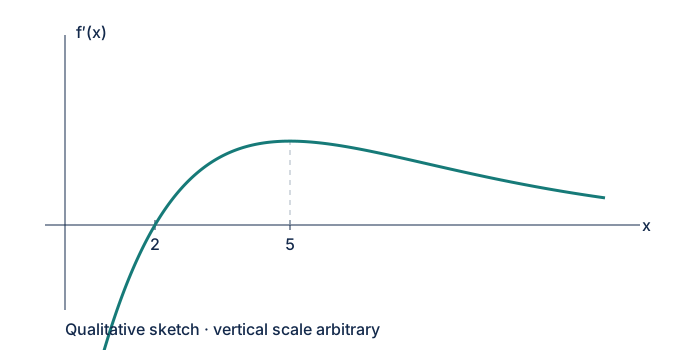
Show solution Hide solution for Question 19 + The original curve decreases up to x = 2 x=2 x = 2 The slope is greatest at the inflection point x = 5 x=5 x = 5 f ′ f\prime f ′ Original solution sketch; see the steps for key values. Answer A curve crossing at
x = 2 x=2 x = 2 , peaking above the axis at
x = 5 x=5 x = 5 , then approaching
y = 0 y=0 y = 0 from above.
Solution time 00:00
Not started
Pause
Reset
Probability
Show solution Hide solution for Question 20(a) + Follow the walk branch and then the incorrect-uniform branch: 3 10 × 1 10 \frac3{10}\times\frac1{10} 10 3 × 10 1 Answer 3 / 100 = 0.03 3/100=0.03 3/100 = 0.03 .
Solution time 00:00
Not started
Pause
Reset
Probability
Show solution Hide solution for Question 20(b) + Using the independent-selection model intended by the tree, the probability a student does not meet both conditions is 1 − 0.03 = 0.97 1-0.03=0.97 1 − 0.03 = 0.97 Answer 1 − 0.9 7 2 = 0.0591 1-0.97^2=0.0591 1 − 0.9 7 2 = 0.0591 .
Solution time 00:00
Not started
Pause
Reset
Differentiation Exponentials & logarithms
Show solution Hide solution for Question 21(a) + Apply the quotient rule, keeping the entire denominator squared. g ′ ( x ) = ( ln x ) ( 1 ) − x ( 1 / x ) ( ln x ) 2 = ln x − 1 ( ln x ) 2 . g\prime(x)=\frac{(\ln x)(1)-x(1/x)}{(\ln x)^2}=\frac{\ln x-1}{(\ln x)^2}. g ′ ( x ) = ( ln x ) 2 ( ln x ) ( 1 ) − x ( 1/ x ) = ( ln x ) 2 ln x − 1 . Answer g ′ ( x ) = ln x − 1 ( ln x ) 2 \displaystyle g\prime(x)=\frac{\ln x-1}{(\ln x)^2} g ′ ( x ) = ( ln x ) 2 ln x − 1 .
Solution time 00:00
Not started
Pause
Reset
Differentiation
Show solution Hide solution for Question 21(b) + The stationary point is x = e x=e x = e Compare the endpoint values: g ( 2 ) = 2 / ln 2 ≈ 2.885 g(2)=2/\ln2\approx2.885 g ( 2 ) = 2/ ln 2 ≈ 2.885 g ( 5 ) = 5 / ln 5 ≈ 3.107 g(5)=5/\ln5\approx3.107 g ( 5 ) = 5/ ln 5 ≈ 3.107 Answer The global maximum is
5 / ln 5 ≈ 3.107 5/\ln5\approx3.107 5/ ln 5 ≈ 3.107 , attained at
x = 5 x=5 x = 5 .
Solution time 00:00
Not started
Pause
Reset
Functions & graphs
Show solution Hide solution for Question 22(a) + Split the numerator as x + 2 = ( x + 1 ) + 1 x+2=(x+1)+1 x + 2 = ( x + 1 ) + 1 x + 1 x+1 x + 1 Answer x + 2 x + 1 = 1 + 1 x + 1 \displaystyle\frac{x+2}{x+1}=1+\frac1{x+1} x + 1 x + 2 = 1 + x + 1 1 , for
x ≠ − 1 x\ne-1 x = − 1 .
Solution time 00:00
Not started
Pause
Reset
Functions & graphs
Show solution Hide solution for Question 22(b) + Replacing x by x + 1 x+1 x + 1 y = 1 / x y=1/x y = 1/ x Answer Translate one unit left and one unit up.
Solution time 00:00
Not started
Pause
Reset
Trigonometry
Show solution Hide solution for Question 23 + Write O A = O B = r OA=OB=r O A = OB = r 80 = 1 2 r 2 sin 4 5 ∘ 80=\tfrac12 r^2\sin45^\circ 80 = 2 1 r 2 sin 4 5 ∘ r = 160 / sin 4 5 ∘ ≈ 15.0424 km r=\sqrt{160/\sin45^\circ}\approx15.0424\text{ km} r = 160/ sin 4 5 ∘ ≈ 15.0424 km The included angle B O C = 25 3 ∘ − 10 1 ∘ = 15 2 ∘ BOC=253^\circ-101^\circ=152^\circ BOC = 25 3 ∘ − 10 1 ∘ = 15 2 ∘ B C = r 2 + 2 5 2 − 2 r ( 25 ) cos 15 2 ∘ ≈ 38.93 km BC=\sqrt{r^2+25^2-2r(25)\cos152^\circ}\approx38.93\text{ km} BC = r 2 + 2 5 2 − 2 r ( 25 ) cos 15 2 ∘ ≈ 38.93 km Answer B C ≈ 39 km BC\approx39\text{ km} BC ≈ 39 km , to the nearest kilometre.
Solution time 00:00
Not started
Pause
Reset
Exponentials & logarithms
Show solution Hide solution for Question 24(a) + If 75% has decayed, 25% remains: 250 = 1000 e 10.54 k 250=1000e^{10.54k} 250 = 1000 e 10.54 k k = ln ( 0.25 ) / 10.54 k=\ln(0.25)/10.54 k = ln ( 0.25 ) /10.54 Answer k ≈ − 0.1315 year − 1 k\approx-0.1315\text{ year}^{-1} k ≈ − 0.1315 year − 1 .
Solution time 00:00
Not started
Pause
Reset
Differentiation Exponentials & logarithms
Show solution Hide solution for Question 24(b) + Differentiate to get A ′ ( t ) = 1000 k e k t A\prime(t)=1000k e^{kt} A ′ ( t ) = 1000 k e k t − 9.48 -9.48 − 9.48 k = ln ( 0.25 ) / 10.54 k=\ln(0.25)/10.54 k = ln ( 0.25 ) /10.54 t = ln ( − 9.48 1000 k ) k ≈ 19.996. t=\frac{\ln\!\left(\frac{-9.48}{1000k}\right)}{k}\approx19.996. t = k ln ( 1000 k − 9.48 ) ≈ 19.996. Answer 20 years, to the nearest year.
Solution time 00:00
Not started
Pause
Reset
Normal distribution Probability
Show solution Hide solution for Question 25 + The upper boundary is 5.89 − 4.82 = 1.07 5.89-4.82=1.07 5.89 − 4.82 = 1.07 4.82 − 3.75 = 1.07 4.82-3.75=1.07 4.82 − 3.75 = 1.07 The area from the mean to the upper boundary is therefore 0.5 − 0.116 0.5-0.116 0.5 − 0.116
Solution time 00:00
Not started
Pause
Reset
Motion
Show solution Hide solution for Question 26(a) + Solve 1 − e cos ( π t ) = 0 1-e^{\cos(\pi t)}=0 1 − e c o s ( π t ) = 0 cos ( π t ) = 0 \cos(\pi t)=0 cos ( π t ) = 0 t = 0.5 t=0.5 t = 0.5 Answer t = 0.5 s t=0.5\text{ s} t = 0.5 s .
Solution time 00:00
Not started
Pause
Reset
Motion Differentiation
Show solution Hide solution for Question 26(b) + Differentiating velocity gives a ( t ) = π e cos ( π t ) sin ( π t ) a(t)=\pi e^{\cos(\pi t)}\sin(\pi t) a ( t ) = π e c o s ( π t ) sin ( π t ) t = 0.5 t=0.5 t = 0.5 Answer a ( 0.5 ) = π m/s 2 a(0.5)=\pi\text{ m/s}^2 a ( 0.5 ) = π m/s 2 .
Solution time 00:00
Not started
Pause
Reset
Motion Integration
Show solution Hide solution for Question 26(c) + Distance integrates speed, so use the absolute values of the velocities. The sign change is at a table point, allowing the trapezoidal rule to be applied across both pieces. D ≈ 0.25 2 [ 1.72 + 2 ( 1.03 + 0 + 0.51 ) + 0.63 ] = 0.67875. D\approx\frac{0.25}{2}[1.72+2(1.03+0+0.51)+0.63]=0.67875. D ≈ 2 0.25 [ 1.72 + 2 ( 1.03 + 0 + 0.51 ) + 0.63 ] = 0.67875. Answer Approximately
0.679 m 0.679\text{ m} 0.679 m .
Solution time 00:00
Not started
Pause
Reset
Financial mathematics Sequences & series
Show solution Hide solution for Question 27 + The half-yearly rate is i = 0.01 i=0.01 i = 0.01 s n = ( ( 1.01 ) n − 1 ) / 0.01 s_n=((1.01)^n-1)/0.01 s n = (( 1.01 ) n − 1 ) /0.01 750 s 10 750s_{10} 750 s 10 750 s m 750s_m 750 s m Thus 750 ( 10.4622 + s m ) ≥ 14000 750(10.4622+s_m)\ge14000 750 ( 10.4622 + s m ) ≥ 14000 s m ≥ 8.20447 s_m\ge8.20447 s m ≥ 8.20447 s 8 = 8.2857 s_8=8.2857 s 8 = 8.2857 Seven doubled payments give s 7 ≈ 7.2135 s_7\approx7.2135 s 7 ≈ 7.2135 Answer A maximum of 2 contributions of $750.
Solution time 00:00
Not started
Pause
Reset
Differentiation Functions & graphs
Show solution Hide solution for Question 28 + Differentiate: y ′ = 12 x 2 − 6 x − 6 = 6 ( 2 x + 1 ) ( x − 1 ) y\prime=12x^2-6x-6=6(2x+1)(x-1) y ′ = 12 x 2 − 6 x − 6 = 6 ( 2 x + 1 ) ( x − 1 ) x = − 1 / 2 x=-1/2 x = − 1/2 x = 1 x=1 x = 1 The derivative signs + , − , + +,-,+ + , − , + − 1 / 2 -1/2 − 1/2 d + 7 / 4 d+7/4 d + 7/4 d − 5 d-5 d − 5 For three distinct crossings, the maximum must be strictly positive and the minimum strictly negative: d + 7 / 4 > 0 d+7/4>0 d + 7/4 > 0 d − 5 < 0 d-5<0 d − 5 < 0 Answer − 7 4 < d < 5 -\tfrac74<d<5 − 4 7 < d < 5 .
Solution time 00:00
Not started
Pause
Reset
Trigonometry Functions & graphs
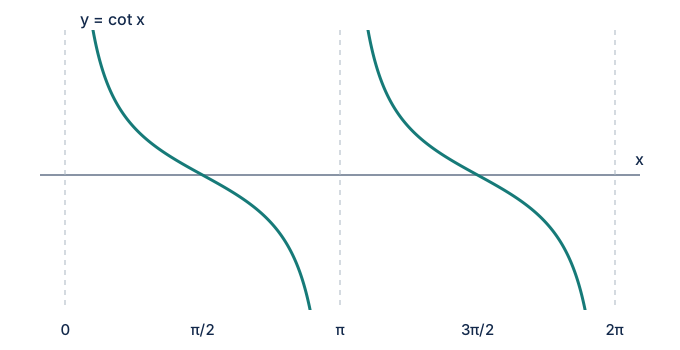
Show solution Hide solution for Question 29(a) + Use cot x = cos x / sin x \cot x=\cos x/\sin x cot x = cos x / sin x x = 0 , π , 2 π x=0,\pi,2\pi x = 0 , π , 2 π x = π / 2 , 3 π / 2 x=\pi/2,3\pi/2 x = π /2 , 3 π /2 Each branch decreases from + ∞ +\infty + ∞ − ∞ -\infty − ∞ Original solution sketch; see the steps for key values. Answer Two decreasing branches, with period
π \pi π .
Solution time 00:00
Not started
Pause
Reset
Trigonometry Exponentials & logarithms
Show solution Hide solution for Question 29(b) + The logarithm needs cot x > 0 \cot x>0 cot x > 0 Answer x ∈ ( 0 , π / 2 ) ∪ ( π , 3 π / 2 ) \displaystyle x\in(0,\pi/2)\cup(\pi,3\pi/2) x ∈ ( 0 , π /2 ) ∪ ( π , 3 π /2 ) .
Solution time 00:00
Not started
Pause
Reset
Differentiation Trigonometry
Show solution Hide solution for Question 29(c) + Use the chain rule and ( cot x ) ′ = − csc 2 x (\cot x)\prime=-\csc^2x ( cot x ) ′ = − csc 2 x d d x ln ( cot x ) = − csc 2 x cot x = − 1 sin x cos x = − csc x sec x . \frac{d}{dx}\ln(\cot x)=\frac{-\csc^2x}{\cot x}=-\frac{1}{\sin x\cos x}=-\csc x\sec x. d x d ln ( cot x ) = cot x − csc 2 x = − sin x cos x 1 = − csc x sec x . Answer − csc x sec x -\csc x\sec x − csc x sec x , wherever
ln ( cot x ) \ln(\cot x) ln ( cot x ) is defined.
Solution time 00:00
Not started
Pause
Reset
Trigonometry
Show solution Hide solution for Question 30(a) + In the right triangle AOM, the height is M O = ℓ sin θ MO=\ell\sin\theta MO = ℓ sin θ A O = ℓ cos θ AO=\ell\cos\theta A O = ℓ cos θ The square’s full diagonal is 2 ℓ cos θ 2\ell\cos\theta 2 ℓ cos θ 2 ℓ 2 cos 2 θ 2\ell^2\cos^2\theta 2 ℓ 2 cos 2 θ Answer V = 2 ℓ 3 3 sin θ cos 2 θ \displaystyle V=\frac{2\ell^3}{3}\sin\theta\cos^2\theta V = 3 2 ℓ 3 sin θ cos 2 θ .
Solution time 00:00
Not started
Pause
Reset
Differentiation Trigonometry
Show solution Hide solution for Question 30(b) + For fixed ℓ > 0 \ell>0 ℓ > 0 V ′ = 2 ℓ 3 3 cos θ ( 1 − 3 sin 2 θ ) V\prime=\frac{2\ell^3}{3}\cos\theta(1-3\sin^2\theta) V ′ = 3 2 ℓ 3 cos θ ( 1 − 3 sin 2 θ ) For a non-degenerate pyramid, 0 < θ < π / 2 0<\theta<\pi/2 0 < θ < π /2 sin θ = 1 / 3 \sin\theta=1/\sqrt3 sin θ = 1/ 3 Answer θ = arcsin ( 1 / 3 ) ≈ 0.62 radians \theta=\arcsin(1/\sqrt3)\approx0.62\text{ radians} θ = arcsin ( 1/ 3 ) ≈ 0.62 radians .
Solution time 00:00
Not started
Pause
Reset
Integration Trigonometry
Show solution Hide solution for Question 31(a) + The derivative of sin ( 2 x ) \sin(2x) sin ( 2 x ) 2 cos ( 2 x ) 2\cos(2x) 2 cos ( 2 x ) Answer ∫ cos ( 2 x ) d x = 1 2 sin ( 2 x ) + C \displaystyle\int\cos(2x)\,dx=\tfrac12\sin(2x)+C ∫ cos ( 2 x ) d x = 2 1 sin ( 2 x ) + C .
Solution time 00:00
Not started
Pause
Reset
Integration Exponentials & logarithms
Show solution Hide solution for Question 31(b) + Since f is positive, ∫ f ′ ( x ) / f ( x ) d x = ln f ( x ) \int f\prime(x)/f(x)\,dx=\ln f(x) ∫ f ′ ( x ) / f ( x ) d x = ln f ( x ) ln f ( x ) = 1 2 sin ( 2 x ) + C \ln f(x)=\tfrac12\sin(2x)+C ln f ( x ) = 2 1 sin ( 2 x ) + C Use f ( 0 ) = 1 f(0)=1 f ( 0 ) = 1 C = 0 C=0 C = 0 Answer f ( x ) = e 1 2 sin ( 2 x ) f(x)=e^{\frac12\sin(2x)} f ( x ) = e 2 1 s i n ( 2 x ) .
Solution time 00:00
Not started
Pause
Reset
Integration
Show solution Hide solution for Question 32(a) + Apply the fundamental theorem using F ′ ( t ) = tan t F\prime(t)=\sqrt{\tan t} F ′ ( t ) = tan t Answer g ( x ) = F ( 1 ) − F ( x 3 ) g(x)=F(1)-F(x^3) g ( x ) = F ( 1 ) − F ( x 3 ) .
Solution time 00:00
Not started
Pause
Reset
Differentiation Integration
Show solution Hide solution for Question 32(b) + The term F ( 1 ) F(1) F ( 1 ) − F ( x 3 ) -F(x^3) − F ( x 3 ) F ′ ( x 3 ) = tan ( x 3 ) F\prime(x^3)=\sqrt{\tan(x^3)} F ′ ( x 3 ) = tan ( x 3 ) Answer g ′ ( x ) = − 3 x 2 tan ( x 3 ) g\prime(x)=-3x^2\sqrt{\tan(x^3)} g ′ ( x ) = − 3 x 2 tan ( x 3 ) .
Solution time 00:00
Not started
Pause
Reset
Financial mathematics Sequences & series
Show solution Hide solution for Question 33(a) + Write r = 1.005 r=1.005 r = 1.005 q = 1.1 q=1.1 q = 1.1 A 1 = 83000 r − 760 A_1=83000r-760 A 1 = 83000 r − 760 A 2 = 83000 r 2 − 760 r − 760 q A_2=83000r^2-760r-760q A 2 = 83000 r 2 − 760 r − 760 q A 3 = 83000 r 3 − 760 r 2 − 760 q r − 760 q 2 A_3=83000r^3-760r^2-760qr-760q^2 A 3 = 83000 r 3 − 760 r 2 − 760 q r − 760 q 2 Answer A 3 = 83000 ( 1.005 ) 3 − 760 [ ( 1.005 ) 2 + ( 1.005 ) ( 1.1 ) + ( 1.1 ) 2 ] A_3=83000(1.005)^3-760[(1.005)^2+(1.005)(1.1)+(1.1)^2] A 3 = 83000 ( 1.005 ) 3 − 760 [( 1.005 ) 2 + ( 1.005 ) ( 1.1 ) + ( 1.1 ) 2 ] .
Solution time 00:00
Not started
Pause
Reset
Financial mathematics Sequences & series
Show solution Hide solution for Question 33(b) + After n repayments, A n = 83000 r n − 760 ∑ j = 0 n − 1 r n − 1 − j q j A_n=83000r^n-760\sum_{j=0}^{n-1}r^{n-1-j}q^j A n = 83000 r n − 760 ∑ j = 0 n − 1 r n − 1 − j q j r = 1.005 r=1.005 r = 1.005 q = 1.1 q=1.1 q = 1.1 The geometric sum equals ( q n − r n ) / ( q − r ) (q^n-r^n)/(q-r) ( q n − r n ) / ( q − r ) 760 / ( 1.1 − 1.005 ) = 8000 760/(1.1-1.005)=8000 760/ ( 1.1 − 1.005 ) = 8000 83000 r n − 8000 ( q n − r n ) 83000r^n-8000(q^n-r^n) 83000 r n − 8000 ( q n − r n ) Answer A n = 91000 ( 1.005 ) n − 8000 ( 1.1 ) n A_n=91000(1.005)^n-8000(1.1)^n A n = 91000 ( 1.005 ) n − 8000 ( 1.1 ) n .
Solution time 00:00
Not started
Pause
Reset
Financial mathematics Sequences & series
Show solution Hide solution for Question 33(c) + The scheduled formula first reaches a non-positive balance when n ≥ ln ( 91000 / 8000 ) / ln ( 1.1 / 1.005 ) ≈ 26.919 n\ge\ln(91000/8000)/\ln(1.1/1.005)\approx26.919 n ≥ ln ( 91000/8000 ) / ln ( 1.1/1.005 ) ≈ 26.919 The amount owing after repayment 26 is A 26 = 91000 ( 1.005 ) 26 − 8000 ( 1.1 ) 26 ≈ 8254.41 A_{26}=91000(1.005)^{26}-8000(1.1)^{26}\approx8254.41 A 26 = 91000 ( 1.005 ) 26 − 8000 ( 1.1 ) 26 ≈ 8254.41 1.005 A 26 ≈ 8295.68 1.005A_{26}\approx8295.68 1.005 A 26 ≈ 8295.68 Answer The final payment is $8295.68.
Solution time 00:00
Not started
Pause
Reset