Section I Multiple choice
Probability
Show solution Hide solution for Question 1 + A probability distribution must add to 1. The missing probability is 1 − 0.4 − 0.2 = 0.4 1-0.4-0.2=0.4 1 − 0.4 − 0.2 = 0.4
Solution time 00:00
Not started
Pause
Reset
Functions & graphs Exponentials & logarithms
Show solution Hide solution for Question 2 + A base greater than 1 gives an increasing exponential curve. It passes through ( 0 , 1 ) (0,1) ( 0 , 1 )
Solution time 00:00
Not started
Pause
Reset
Functions & graphs
Show solution Hide solution for Question 3 + A real square root requires a non-negative radicand: 6 − x 2 ≥ 0 6-x^2\geq0 6 − x 2 ≥ 0 x 2 ≤ 6 x^2\leq6 x 2 ≤ 6 Answer D:
[ − 6 , 6 ] [-\sqrt6,\sqrt6] [ − 6 , 6 ] .
Solution time 00:00
Not started
Pause
Reset
Functions & graphs
Show solution Hide solution for Question 4 + Rewrite the expression as 5 x ( x − 2 ) ( x − 3 ) 5x(x-2)(x-3) 5 x ( x − 2 ) ( x − 3 )
Solution time 00:00
Not started
Pause
Reset
Integration
Show solution Hide solution for Question 5 + Write the integrand as ( x + 5 ) − 1 / 2 (x+5)^{-1/2} ( x + 5 ) − 1/2 d ( x + 5 ) / d x = 1 d(x+5)/dx=1 d ( x + 5 ) / d x = 1 ∫ ( x + 5 ) − 1 / 2 d x = 2 x + 5 + C . \int (x+5)^{-1/2}\,dx=2\sqrt{x+5}+C. ∫ ( x + 5 ) − 1/2 d x = 2 x + 5 + C . Answer B:
2 x + 5 + C 2\sqrt{x+5}+C 2 x + 5 + C .
Solution time 00:00
Not started
Pause
Reset
Functions & graphs
Show solution Hide solution for Question 6 + The transformation maps every point ( x , y ) (x,y) ( x , y ) ( − x , − y ) (-x,-y) ( − x , − y ) x = 2 x=2 x = 2 y = − 1 y=-1 y = − 1 ( 0 , − 3 ) (0,-3) ( 0 , − 3 )
Solution time 00:00
Not started
Pause
Reset
Probability
Show solution Hide solution for Question 7 + The estimated probability left for the other nine faces is ( 153 − 72 ) / 153 = 81 / 153 (153-72)/153=81/153 ( 153 − 72 ) /153 = 81/153 P ( 10 ) ≈ 81 153 × 9 = 1 17 . P(10)\approx\frac{81}{153\times9}=\frac1{17}. P ( 10 ) ≈ 153 × 9 81 = 17 1 .
Solution time 00:00
Not started
Pause
Reset
Statistics Normal distribution
Show solution Hide solution for Question 8 + Since μ = σ \mu=\sigma μ = σ z = ( 0 − μ ) / σ = − 1 z=(0-\mu)/\sigma=-1 z = ( 0 − μ ) / σ = − 1 − 1 -1 − 1 50 % + 34 % = 84 % 50\%+34\%=84\% 50% + 34% = 84% Answer D: approximately 84%.
Solution time 00:00
Not started
Pause
Reset
Differentiation Functions & graphs
Show solution Hide solution for Question 9 + Between x = 1 x=1 x = 1 x = 1.1 x=1.1 x = 1.1 f f f 2 ( 0.1 ) = 0.2 2(0.1)=0.2 2 ( 0.1 ) = 0.2 0 < ∫ 1 1.1 f ′ ( x ) d x < 0.2 ⟹ 6 < f ( 1.1 ) < 6.2. 0<\int_1^{1.1}f\prime(x)\,dx<0.2\quad\Longrightarrow\quad6<f(1.1)<6.2. 0 < ∫ 1 1.1 f ′ ( x ) d x < 0.2 ⟹ 6 < f ( 1.1 ) < 6.2. The tangent estimate 6.2 is an upper estimate here; the decreasing slope puts the actual value just below it. Answer B:
[ 6.0 , 6.2 ) [6.0,6.2) [ 6.0 , 6.2 ) .
Solution time 00:00
Not started
Pause
Reset
Differentiation Functions & graphs Exponentials & logarithms
Show solution Hide solution for Question 10 + The chain rule gives d d x f ( e x ) = e x f ′ ( e x ) \frac{d}{dx}f(e^x)=e^x f\prime(e^x) d x d f ( e x ) = e x f ′ ( e x ) e x > 0 e^x>0 e x > 0 f ′ ( e x ) = 0 f\prime(e^x)=0 f ′ ( e x ) = 0 Only the two stationary points of f f f e x e^x e x x x x Answer C: 2 stationary points.
Solution time 00:00
Not started
Pause
Reset
Section II Written responses
Functions & graphs
Show solution Hide solution for Question 11(a) + Complete the square: h = t 2 − 8 t + 12 = ( t − 4 ) 2 − 4 h=t^2-8t+12=(t-4)^2-4 h = t 2 − 8 t + 12 = ( t − 4 ) 2 − 4 t = 4 t=4 t = 4 h = − 4 h=-4 h = − 4 Answer ( t , h ) = ( 4 , − 4 ) (t,h)=(4,-4) ( t , h ) = ( 4 , − 4 ) .
Solution time 00:00
Not started
Pause
Reset
Functions & graphs
Show solution Hide solution for Question 11(b) + Set h = 12 h=12 h = 12 t 2 − 8 t + 12 = 12 t^2-8t+12=12 t 2 − 8 t + 12 = 12 t ( t − 8 ) = 0 t(t-8)=0 t ( t − 8 ) = 0 t = 0 t=0 t = 0
Solution time 00:00
Not started
Pause
Reset
Differentiation
Show solution Hide solution for Question 12 + Use powers to differentiate: y = 5 x 3 − 2 x − 2 − 9 y=5x^3-2x^{-2}-9 y = 5 x 3 − 2 x − 2 − 9 y ′ = 15 x 2 + 4 x − 3 y\prime=15x^2+4x^{-3} y ′ = 15 x 2 + 4 x − 3 x = 1 x=1 x = 1 The point-gradient equation is y + 6 = 19 ( x − 1 ) y+6=19(x-1) y + 6 = 19 ( x − 1 ) Answer y = 19 x − 25 y=19x-25 y = 19 x − 25 .
Solution time 00:00
Not started
Pause
Reset
Sequences & series
Show solution Hide solution for Question 13 + Three multiplications by the common ratio take 75 to 2025: 75 r 3 = 2025 75r^3=2025 75 r 3 = 2025 r 3 = 27 r^3=27 r 3 = 27 r = 3 r=3 r = 3 The intermediate terms are p = 75 ( 3 ) p=75(3) p = 75 ( 3 ) q = 75 ( 3 2 ) q=75(3^2) q = 75 ( 3 2 ) Answer p = 225 , q = 675 p=225,\ q=675 p = 225 , q = 675 .
Solution time 00:00
Not started
Pause
Reset
Statistics Regression
Show solution Hide solution for Question 14(a) + The points form a roughly straight, downward-sloping band. Larger television times tend to be paired with smaller exercise times. Answer Approximately linear form; negative direction.
Solution time 00:00
Not started
Pause
Reset
Statistics Regression
Show solution Hide solution for Question 14(b) + The slope −0.7 means that each additional minute of average daily television time is associated with 0.7 fewer predicted minutes of daily exercise. The intercept 64.3 predicts 64.3 minutes of daily exercise for someone with zero average daily television time. These are predictions from an association, not evidence that television causes the change. Answer Slope: −0.7 minutes per minute. Intercept: 64.3 minutes at zero television time.
Solution time 00:00
Not started
Pause
Reset
Statistics Regression
Show solution Hide solution for Question 14(c) + Substitute the television time into the fitted line: y ^ = 64.3 − 0.7 ( 42 ) = 34.9 \hat y=64.3-0.7(42)=34.9 y ^ = 64.3 − 0.7 ( 42 ) = 34.9 Answer 34.9 minutes of exercise per day.
Solution time 00:00
Not started
Pause
Reset
Statistics Regression
Show solution Hide solution for Question 14(d) + Two hours is 120 minutes, well beyond the observed range (about 0–60 minutes). The observed linear pattern need not continue that far. It would even give 64.3 − 0.7 ( 120 ) = − 19.7 64.3-0.7(120)=-19.7 64.3 − 0.7 ( 120 ) = − 19.7 Answer The prediction extrapolates far beyond the data and gives an impossible negative duration.
Solution time 00:00
Not started
Pause
Reset
Trigonometry Functions & graphs
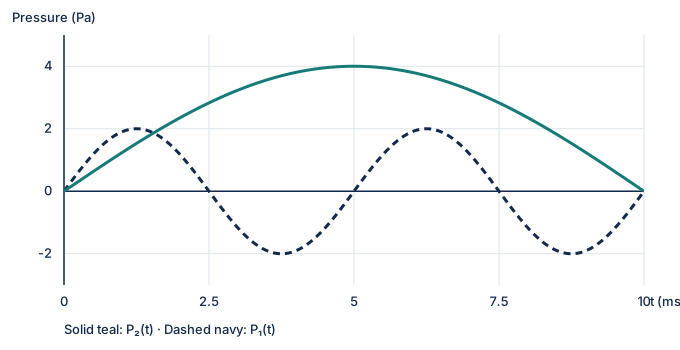
Show solution Hide solution for Question 15(a) + The amplitude sets k = 2 k=2 k = 2 2 π / a 2\pi/a 2 π / a 2 π / a = 5 2\pi/a=5 2 π / a = 5 a = 2 π / 5 a=2\pi/5 a = 2 π /5 Answer P 1 ( t ) = 2 sin ( 2 π t / 5 ) P_1(t)=2\sin(2\pi t/5) P 1 ( t ) = 2 sin ( 2 π t /5 ) .
Solution time 00:00
Not started
Pause
Reset
Trigonometry Functions & graphs
Show solution Hide solution for Question 15(b) + The second wave has amplitude 4 and period 2 π / ( π / 10 ) = 20 2\pi/(\pi/10)=20 2 π / ( π /10 ) = 20 Draw a smooth arch from ( 0 , 0 ) (0,0) ( 0 , 0 ) ( 5 , 4 ) (5,4) ( 5 , 4 ) ( 10 , 0 ) (10,0) ( 10 , 0 ) Original solution sketch; see the steps for key values. Answer A positive half-sine wave with peak
( 5 , 4 ) (5,4) ( 5 , 4 ) .
Solution time 00:00
Not started
Pause
Reset
Trigonometry Differentiation
Show solution Hide solution for Question 15(c) + P 1 ′ ( t ) = ( 4 π / 5 ) cos ( 2 π t / 5 ) P_1\prime(t)=(4\pi/5)\cos(2\pi t/5) P 1 ′ ( t ) = ( 4 π /5 ) cos ( 2 π t /5 ) ( 1.25 , 3.75 ) (1.25,3.75) ( 1.25 , 3.75 ) ( 6.25 , 8.75 ) (6.25,8.75) ( 6.25 , 8.75 ) P 2 ′ ( t ) = ( 2 π / 5 ) cos ( π t / 10 ) P_2\prime(t)=(2\pi/5)\cos(\pi t/10) P 2 ′ ( t ) = ( 2 π /5 ) cos ( π t /10 ) ( 5 , 10 ) (5,10) ( 5 , 10 ) Answer 6.25 < t < 8.75 6.25<t<8.75 6.25 < t < 8.75 ms.
Solution time 00:00
Not started
Pause
Reset
Differentiation Exponentials & logarithms
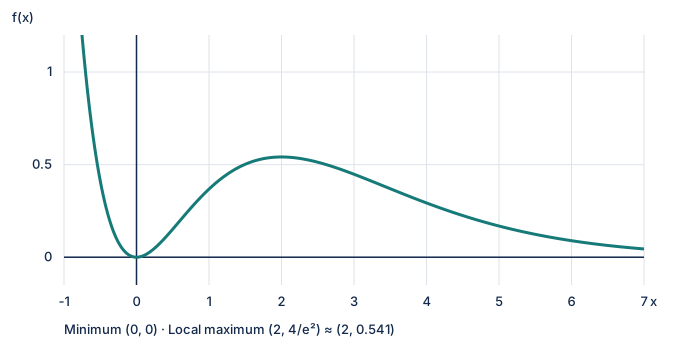
Show solution Hide solution for Question 16(a) + Write f ( x ) = x 2 e − x f(x)=x^2e^{-x} f ( x ) = x 2 e − x f ′ ( x ) = e − x ( 2 x − x 2 ) = x e − x ( 2 − x ) f\prime(x)=e^{-x}(2x-x^2)=xe^{-x}(2-x) f ′ ( x ) = e − x ( 2 x − x 2 ) = x e − x ( 2 − x ) The derivative signs are negative for x < 0 x<0 x < 0 0 < x < 2 0<x<2 0 < x < 2 x > 2 x>2 x > 2 f ( 0 ) = 0 f(0)=0 f ( 0 ) = 0 f ( 2 ) = 4 / e 2 ≈ 0.5413 f(2)=4/e^2\approx0.5413 f ( 2 ) = 4/ e 2 ≈ 0.5413 Answer Local minimum
( 0 , 0 ) (0,0) ( 0 , 0 ) ; local maximum
( 2 , 4 / e 2 ) (2,4/e^2) ( 2 , 4/ e 2 ) .
Solution time 00:00
Not started
Pause
Reset
Functions & graphs Differentiation
Show solution Hide solution for Question 16(b) + Join the left branch smoothly to the minimum at the origin. Rise to ( 2 , 4 / e 2 ) (2,4/e^2) ( 2 , 4/ e 2 ) y = 0 y=0 y = 0 Original solution sketch; see the steps for key values. Answer A smooth curve through both stationary points, approaching
y = 0 y=0 y = 0 as
x → ∞ x\to\infty x → ∞ .
Solution time 00:00
Not started
Pause
Reset
Financial maths Sequences & series
Show solution Hide solution for Question 17(a) + Interest is applied before the repayment, so A n + 1 = 1.005 A n − 5740 A_{n+1}=1.005A_n-5740 A n + 1 = 1.005 A n − 5740 A 0 = 800000 A_0=800000 A 0 = 800000 A 1 = 800000 ( 1.005 ) − 5740 , A_1=800000(1.005)-5740, A 1 = 800000 ( 1.005 ) − 5740 , A 2 = 1.005 [ 800000 ( 1.005 ) − 5740 ] − 5740. A_2=1.005[800000(1.005)-5740]-5740. A 2 = 1.005 [ 800000 ( 1.005 ) − 5740 ] − 5740. Answer A 2 = 800000 ( 1.005 ) 2 − 5740 ( 1.005 ) − 5740 A_2=800000(1.005)^2-5740(1.005)-5740 A 2 = 800000 ( 1.005 ) 2 − 5740 ( 1.005 ) − 5740 .
Solution time 00:00
Not started
Pause
Reset
Financial maths Sequences & series
Show solution Hide solution for Question 17(b) + After n n n A n = 800000 ( 1.005 ) n − 5740 ∑ j = 0 n − 1 ( 1.005 ) j . A_n=800000(1.005)^n-5740\sum_{j=0}^{n-1}(1.005)^j. A n = 800000 ( 1.005 ) n − 5740 j = 0 ∑ n − 1 ( 1.005 ) j . The geometric sum is [ ( 1.005 ) n − 1 ] / 0.005 [(1.005)^n-1]/0.005 [( 1.005 ) n − 1 ] /0.005 5740 / 0.005 = 1148000 5740/0.005=1148000 5740/0.005 = 1148000 ( 1.005 ) n (1.005)^n ( 1.005 ) n Answer A n = 1148000 − 348000 ( 1.005 ) n A_n=1148000-348000(1.005)^n A n = 1148000 − 348000 ( 1.005 ) n .
Solution time 00:00
Not started
Pause
Reset
Financial maths Exponentials & logarithms
Show solution Hide solution for Question 17(c) + Rearrange the strict inequality: 1148000 − 348000 ( 1.005 ) n < 400000 1148000-348000(1.005)^n<400000 1148000 − 348000 ( 1.005 ) n < 400000 ( 1.005 ) n > 748000 / 348000 (1.005)^n>748000/348000 ( 1.005 ) n > 748000/348000 n > ln ( 748000 / 348000 ) ln ( 1.005 ) ≈ 153.422. n>\frac{\ln(748000/348000)}{\ln(1.005)}\approx153.422. n > ln ( 1.005 ) ln ( 748000/348000 ) ≈ 153.422. The first whole month after this threshold is 154. The balances after months 153 and 154 are about $401,574.11 and $397,841.98 respectively.
Solution time 00:00
Not started
Pause
Reset
Functions & graphs
Show solution Hide solution for Question 18 + Composing gives g ( f ( x ) ) = 3 / ( x − 1 ) + 5 g(f(x))=3/(x-1)+5 g ( f ( x )) = 3/ ( x − 1 ) + 5 x ≠ 1 x\ne1 x = 1 Every other output y y y x = 1 + 3 / ( y − 5 ) x=1+3/(y-5) x = 1 + 3/ ( y − 5 ) Answer ( − ∞ , 5 ) ∪ ( 5 , ∞ ) ( -\infty,5)\cup(5,\infty) ( − ∞ , 5 ) ∪ ( 5 , ∞ ) , or
R ∖ { 5 } \mathbb R\setminus\{5\} R ∖ { 5 } .
Solution time 00:00
Not started
Pause
Reset
Probability Conditional probability
Show solution Hide solution for Question 19 + Let W W W 1 / 6 , 2 / 6 , 3 / 6 1/6,2/6,3/6 1/6 , 2/6 , 3/6 P ( W ) = 1 6 ( 0.5 ) + 2 6 ( 0.4 ) + 3 6 ( 0.2 ) = 19 60 . P(W)=\tfrac16(0.5)+\tfrac26(0.4)+\tfrac36(0.2)=\frac{19}{60}. P ( W ) = 6 1 ( 0.5 ) + 6 2 ( 0.4 ) + 6 3 ( 0.2 ) = 60 19 . The joint probability of selecting Amara and winning is ( 1 / 6 ) ( 0.5 ) = 5 / 60 (1/6)(0.5)=5/60 ( 1/6 ) ( 0.5 ) = 5/60 P ( A ∣ W ) = ( 5 / 60 ) / ( 19 / 60 ) P(A\mid W)=(5/60)/(19/60) P ( A ∣ W ) = ( 5/60 ) / ( 19/60 ) Answer 5 / 19 ≈ 0.2632 5/19\approx0.2632 5/19 ≈ 0.2632 .
Solution time 00:00
Not started
Pause
Reset
Financial maths
Show solution Hide solution for Question 20 + Use the monthly rate 0.06 / 12 = 0.005 0.06/12=0.005 0.06/12 = 0.005 7 ( 12 ) = 84 7(12)=84 7 ( 12 ) = 84 21000 ( 1.005 ) 84 ≈ 31927.7624 21000(1.005)^{84}\approx31927.7624 21000 ( 1.005 ) 84 ≈ 31927.7624 For end-of-month deposits of M M M 104.07393 M 104.07393M 104.07393 M M = 31927.7624 / 104.07393 ≈ 306.7796 M=31927.7624/104.07393\approx306.7796 M = 31927.7624/104.07393 ≈ 306.7796
Solution time 00:00
Not started
Pause
Reset
Probability Continuous distributions
Show solution Hide solution for Question 21(a) + The mode is the input where the density is highest. On [ 1 , e ] [1,e] [ 1 , e ] f ′ ( x ) = − 1 / x 2 < 0 f\prime(x)=-1/x^2<0 f ′ ( x ) = − 1/ x 2 < 0
Solution time 00:00
Not started
Pause
Reset
Probability Continuous distributions Integration
Show solution Hide solution for Question 21(b) + The lower quartile leaves probability 0.25 to its left. Accumulate the density from the lower endpoint: ∫ 1 Q 1 1 x d x = ln Q 1 = 0.25. \int_1^{Q_1}\frac1x\,dx=\ln Q_1=0.25. ∫ 1 Q 1 x 1 d x = ln Q 1 = 0.25. Exponentiating gives Q 1 = e 1 / 4 ≈ 1.284025 Q_1=e^{1/4}\approx1.284025 Q 1 = e 1/4 ≈ 1.284025 Answer Q 1 = 1.284 Q_1=1.284 Q 1 = 1.284 to three decimal places.
Solution time 00:00
Not started
Pause
Reset
Trigonometry
Show solution Hide solution for Question 22 + Use a common denominator on the left. The numerator becomes a perfect square: sin 4 θ + cos 4 θ + 2 sin 2 θ cos 2 θ sin 2 θ cos 2 θ = ( sin 2 θ + cos 2 θ ) 2 sin 2 θ cos 2 θ . \frac{\sin^4\theta+\cos^4\theta+2\sin^2\theta\cos^2\theta}{\sin^2\theta\cos^2\theta}=\frac{(\sin^2\theta+\cos^2\theta)^2}{\sin^2\theta\cos^2\theta}. sin 2 θ cos 2 θ sin 4 θ + cos 4 θ + 2 sin 2 θ cos 2 θ = sin 2 θ cos 2 θ ( sin 2 θ + cos 2 θ ) 2 . Now use sin 2 θ + cos 2 θ = 1 \sin^2\theta+\cos^2\theta=1 sin 2 θ + cos 2 θ = 1 sin θ cos θ ≠ 0 \sin\theta\cos\theta\ne0 sin θ cos θ = 0 Answer 1 / ( sin 2 θ cos 2 θ ) = sec 2 θ cosec 2 θ 1/(\sin^2\theta\cos^2\theta)=\sec^2\theta\,\operatorname{cosec}^2\theta 1/ ( sin 2 θ cos 2 θ ) = sec 2 θ cosec 2 θ .
Solution time 00:00
Not started
Pause
Reset
Statistics Normal distribution
Show solution Hide solution for Question 23(a) + There are 12600 / 21 = 600 12600/21=600 12600/21 = 600 15 / 600 = 0.025 15/600=0.025 15/600 = 0.025 Using the 95% empirical rule, the upper 2.5% begins about two standard deviations above the mean. Thus x ≈ 76.2 + 2 ( 6.8 ) = 89.8 x\approx76.2+2(6.8)=89.8 x ≈ 76.2 + 2 ( 6.8 ) = 89.8 If using an inverse-normal calculator instead, z 0.975 ≈ 1.960 z_{0.975}\approx1.960 z 0.975 ≈ 1.960 x ≈ 89.53 x\approx89.53 x ≈ 89.53 Answer Approximately
89.8 89.8 89.8 kg using the empirical rule.
Solution time 00:00
Not started
Pause
Reset
Statistics Normal distribution
Show solution Hide solution for Question 23(b) + There are 12000 females, so 300 would again be 2.5%. But their mean is lower, making x − μ x-\mu x − μ The female upper-tail proportion is therefore smaller than the male upper-tail proportion. The expected count above the cutoff is less than 300. Answer No; fewer than 300 females are expected above the cutoff.
Solution time 00:00
Not started
Pause
Reset
Differentiation Exponentials & logarithms
Show solution Hide solution for Question 24 + The line has gradient 1. For the logarithmic curve, y ′ = e / x y\prime=e/x y ′ = e / x e / x = 1 e/x=1 e / x = 1 x = e x=e x = e e ln e = e e\ln e=e e ln e = e At that same point the quadratic has derivative 2 a e = 1 2ae=1 2 a e = 1 a = 1 / ( 2 e ) a=1/(2e) a = 1/ ( 2 e ) e = a e 2 + c = e / 2 + c e=ae^2+c=e/2+c e = a e 2 + c = e /2 + c Answer a = 1 / ( 2 e ) , c = e / 2 a=1/(2e),\quad c=e/2 a = 1/ ( 2 e ) , c = e /2 .
Solution time 00:00
Not started
Pause
Reset
Differentiation Integration
Show solution Hide solution for Question 25(a) + Apply the product rule to x cos x x\cos x x cos x d d x ( sin x − x cos x ) = cos x − ( cos x − x sin x ) = x sin x . \frac{d}{dx}(\sin x-x\cos x)=\cos x-(\cos x-x\sin x)=x\sin x. d x d ( sin x − x cos x ) = cos x − ( cos x − x sin x ) = x sin x . Answer The derivative is
x sin x x\sin x x sin x , as required.
Solution time 00:00
Not started
Pause
Reset
Integration Trigonometry
Show solution Hide solution for Question 25(b) + Part (a) supplies the antiderivative. At the upper limit, sin ( 2025 π ) = 0 \sin(2025\pi)=0 sin ( 2025 π ) = 0 cos ( 2025 π ) = − 1 \cos(2025\pi)=-1 cos ( 2025 π ) = − 1 ∫ 0 2025 π x sin x d x = [ sin x − x cos x ] 0 2025 π = 2025 π . \int_0^{2025\pi}x\sin x\,dx=[\sin x-x\cos x]_0^{2025\pi}=2025\pi. ∫ 0 2025 π x sin x d x = [ sin x − x cos x ] 0 2025 π = 2025 π .
Solution time 00:00
Not started
Pause
Reset
Integration Sequences & series
Show solution Hide solution for Question 25(c) + Area counts every lobe positively. There are 2025 lobes, so sum the supplied absolute areas: A = π ∑ n = 1 2025 ( 2 n − 1 ) = π 2025 ( 1 + 4049 ) 2 = 202 5 2 π . A=\pi\sum_{n=1}^{2025}(2n-1)=\pi\frac{2025(1+4049)}2=2025^2\pi. A = π n = 1 ∑ 2025 ( 2 n − 1 ) = π 2 2025 ( 1 + 4049 ) = 202 5 2 π . This is much larger than the signed integral because the regions below the axis no longer cancel regions above it. Answer 4100625 π 4100625\pi 4100625 π square units.
Solution time 00:00
Not started
Pause
Reset
Optimisation Functions & graphs
Show solution Hide solution for Question 26(a) + The perimeter constraint is 2 π r + 3 x = 100 2\pi r+3x=100 2 π r + 3 x = 100 r = ( 100 − 3 x ) / ( 2 π ) r=(100-3x)/(2\pi) r = ( 100 − 3 x ) / ( 2 π ) 1 2 x 2 sin 6 0 ∘ = 3 x 2 / 4 \tfrac12x^2\sin60^\circ=\sqrt3 x^2/4 2 1 x 2 sin 6 0 ∘ = 3 x 2 /4 Add the circle area π r 2 = ( 100 − 3 x ) 2 / ( 4 π ) \pi r^2=(100-3x)^2/(4\pi) π r 2 = ( 100 − 3 x ) 2 / ( 4 π ) 1 / 4 1/4 1/4 Answer A ( x ) = 1 4 ( 3 x 2 + ( 100 − 3 x ) 2 π ) A(x)=\tfrac14\left(\sqrt3 x^2+\frac{(100-3x)^2}{\pi}\right) A ( x ) = 4 1 ( 3 x 2 + π ( 100 − 3 x ) 2 ) .
Solution time 00:00
Not started
Pause
Reset
Optimisation Functions & graphs
Show solution Hide solution for Question 26(b) + The allowable interval is 0 ≤ x ≤ 100 / 3 0\leq x\leq100/3 0 ≤ x ≤ 100/3 x 2 x^2 x 2 ( 3 + 9 / π ) / 4 > 0 (\sqrt3+9/\pi)/4>0 ( 3 + 9/ π ) /4 > 0 A ( 0 ) = 2500 π ≈ 795.77 , A ( 100 / 3 ) = 2500 3 9 ≈ 481.13. A(0)=\frac{2500}{\pi}\approx795.77,\qquad A(100/3)=\frac{2500\sqrt3}{9}\approx481.13. A ( 0 ) = π 2500 ≈ 795.77 , A ( 100/3 ) = 9 2500 3 ≈ 481.13. The larger endpoint value is at x = 0 x=0 x = 0 Answer Maximum area
2500 / π cm 2 2500/\pi\text{ cm}^2 2500/ π cm 2 , when all the wire forms the circle.
Solution time 00:00
Not started
Pause
Reset
Integration Numerical methods
Show solution Hide solution for Question 27(a) + Two equal strips over [ 0 , 2 ] [0,2] [ 0 , 2 ] 1 , 1 / 2 , 1 / 4 1,1/2,1/4 1 , 1/2 , 1/4 T = 1 2 ( 1 + 2 ⋅ 1 2 + 1 4 ) = 9 8 . T=\frac12\left(1+2\cdot\frac12+\frac14\right)=\frac98. T = 2 1 ( 1 + 2 ⋅ 2 1 + 4 1 ) = 8 9 . Answer 9 / 8 = 1.125 9/8=1.125 9/8 = 1.125 square units.
Solution time 00:00
Not started
Pause
Reset
Integration Exponentials & logarithms
Show solution Hide solution for Question 27(b) + Write ( 1 / 2 ) x = e − x ln 2 (1/2)^x=e^{-x\ln2} ( 1/2 ) x = e − x l n 2 − 2 − x / ln 2 -2^{-x}/\ln2 − 2 − x / ln 2 A = [ − 2 − x ln 2 ] 0 2 = 1 − 1 / 4 ln 2 = 3 4 ln 2 . A=\left[-\frac{2^{-x}}{\ln2}\right]_0^2=\frac{1-1/4}{\ln2}=\frac3{4\ln2}. A = [ − ln 2 2 − x ] 0 2 = ln 2 1 − 1/4 = 4 ln 2 3 . Answer 3 / ( 4 ln 2 ) 3/(4\ln2) 3/ ( 4 ln 2 ) square units.
Solution time 00:00
Not started
Pause
Reset
Integration Exponentials & logarithms Numerical methods
Show solution Hide solution for Question 27(c) + The curve is strictly concave up, since y ′ ′ = ( ln 2 ) 2 2 − x > 0 y\prime\prime=(\ln2)^2 2^{-x}>0 y ′′ = ( ln 2 ) 2 2 − x > 0 3 / ( 4 ln 2 ) < 9 / 8 3/(4\ln2)<9/8 3/ ( 4 ln 2 ) < 9/8 As ln 2 > 0 \ln2>0 ln 2 > 0 ln 2 > 2 / 3 \ln2>2/3 ln 2 > 2/3 ln ( 2 2 ) = 3 2 ln 2 > 1 = ln e \ln(2\sqrt2)=\tfrac32\ln2>1=\ln e ln ( 2 2 ) = 2 3 ln 2 > 1 = ln e
Solution time 00:00
Not started
Pause
Reset
Trigonometry
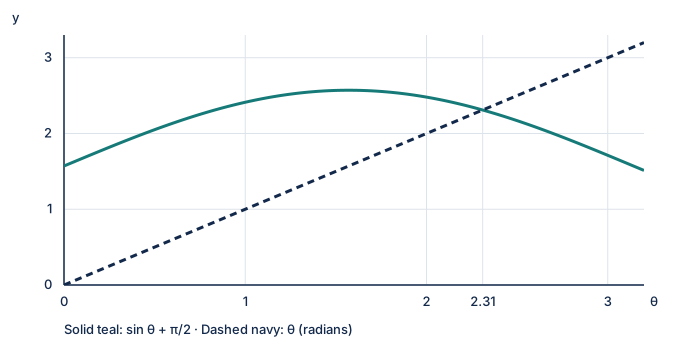
Show solution Hide solution for Question 28(a) + The smaller segment is the sector minus its isosceles triangle. In radians its area is 1 2 ( 10 ) 2 ( θ − sin θ ) \tfrac12(10)^2(\theta-\sin\theta) 2 1 ( 10 ) 2 ( θ − sin θ ) It occupies a quarter of the circle: 50 ( θ − sin θ ) = 25 π 50(\theta-\sin\theta)=25\pi 50 ( θ − sin θ ) = 25 π Answer θ = sin θ + π / 2 \theta=\sin\theta+\pi/2 θ = sin θ + π /2 .
Solution time 00:00
Not started
Pause
Reset
Trigonometry Numerical methods
Show solution Hide solution for Question 28(b) + Add the line y = θ y=\theta y = θ y = sin θ + π / 2 y=\sin\theta+\pi/2 y = sin θ + π /2 θ = 2.3 \theta=2.3 θ = 2.3 Arc length is s = r θ s=r\theta s = r θ s ≈ 10 ( 2.3 ) = 23 s\approx10(2.3)=23 s ≈ 10 ( 2.3 ) = 23 Original solution sketch; see the steps for key values. Answer Approximately 23 m.
Solution time 00:00
Not started
Pause
Reset
Trigonometry
Show solution Hide solution for Question 29(a) + In the vertical right triangle through Y Y Y tan 6 0 ∘ = h / O Y \tan60^\circ=h/OY tan 6 0 ∘ = h / O Y tan 6 0 ∘ = 3 \tan60^\circ=\sqrt3 tan 6 0 ∘ = 3 Answer O Y = h / 3 OY=h/\sqrt3 O Y = h / 3 .
Solution time 00:00
Not started
Pause
Reset
Trigonometry
Show solution Hide solution for Question 29(b) + The 45° elevation at F F F O F = h OF=h OF = h ∠ O Y F = 4 5 ∘ \angle OYF=45^\circ ∠ O Y F = 4 5 ∘ h 2 = ( h 3 ) 2 + 4 2 − 2 ( h 3 ) 4 cos 4 5 ∘ . h^2=\left(\frac h{\sqrt3}\right)^2+4^2-2\left(\frac h{\sqrt3}\right)4\cos45^\circ. h 2 = ( 3 h ) 2 + 4 2 − 2 ( 3 h ) 4 cos 4 5 ∘ . Simplifying gives h 2 + 2 6 h − 24 = 0 h^2+2\sqrt6h-24=0 h 2 + 2 6 h − 24 = 0 h = 30 − 6 ≈ 3.027736 h=\sqrt{30}-\sqrt6\approx3.027736 h = 30 − 6 ≈ 3.027736 Answer h = 3.03 h=3.03 h = 3.03 km to two decimal places.
Solution time 00:00
Not started
Pause
Reset
Trigonometry
Show solution Hide solution for Question 29(c) + Use east and north as positive directions and place Y Y Y ( 0 , 0 ) (0,0) ( 0 , 0 ) F = ( − 2 2 , − 2 2 ) F=(-2\sqrt2,-2\sqrt2) F = ( − 2 2 , − 2 2 ) O = ( − h / 3 , 0 ) O=(-h/\sqrt3,0) O = ( − h / 3 , 0 ) From F F F O O O 2 2 − h / 3 2\sqrt2-h/\sqrt3 2 2 − h / 3 2 2 2\sqrt2 2 2 β = tan − 1 ( 2 2 − h / 3 2 2 ) ≈ 20.90 5 ∘ . \beta=\tan^{-1}\!\left(\frac{2\sqrt2-h/\sqrt3}{2\sqrt2}\right)\approx20.905^\circ. β = tan − 1 ( 2 2 2 2 − h / 3 ) ≈ 20.90 5 ∘ . Use the unrounded height from part (b), and express the final bearing with three digits. Answer Bearing
02 1 ∘ 021^\circ 02 1 ∘ .
Solution time 00:00
Not started
Pause
Reset
Functions & graphs
Show solution Hide solution for Question 30 + A shift right by k k k x x x x − k x-k x − k k k k k k k y = ( x − k − 1 ) ( x − k − 5 ) + k y=(x-k-1)(x-k-5)+k y = ( x − k − 1 ) ( x − k − 5 ) + k Substitute ( 6 , 11 ) (6,11) ( 6 , 11 ) 11 = ( 5 − k ) ( 1 − k ) + k = k 2 − 5 k + 5 11=(5-k)(1-k)+k=k^2-5k+5 11 = ( 5 − k ) ( 1 − k ) + k = k 2 − 5 k + 5 k 2 − 5 k − 6 = ( k − 6 ) ( k + 1 ) = 0 k^2-5k-6=(k-6)(k+1)=0 k 2 − 5 k − 6 = ( k − 6 ) ( k + 1 ) = 0
Solution time 00:00
Not started
Pause
Reset
Trigonometry Functions & graphs
Show solution Hide solution for Question 31 + Set u = p x u=px u = p x p > 0 p>0 p > 0 0 ≤ u ≤ 2 π p 0\leq u\leq2\pi p 0 ≤ u ≤ 2 π p cos u = 1 / 2 \cos u=1/2 cos u = 1/2 π / 3 , 5 π / 3 , 7 π / 3 \pi/3,5\pi/3,7\pi/3 π /3 , 5 π /3 , 7 π /3 Exactly two solutions means including the second but stopping before the third: 5 π / 3 ≤ 2 π p < 7 π / 3 5\pi/3\leq2\pi p<7\pi/3 5 π /3 ≤ 2 π p < 7 π /3 2 π 2\pi 2 π The lower endpoint is included because it admits the second solution; the upper endpoint is excluded because it would admit a third. Answer 5 6 ≤ p < 7 6 \frac56\leq p<\frac76 6 5 ≤ p < 6 7 .
Solution time 00:00
Not started
Pause
Reset